
Yes Does Not Mean Yes: Decoding Communication in ASEAN
Apr 9, 2026 12:00:00 PM • Written by: We are Brand Utility
Scenario: You are a leader running a Zoom meeting with your new team in Thailand or Indonesia.
You propose a new aggressive deadline. You ask, "Can we do this?" The team nods. They smile. They say, "Yes, we will try."
Two weeks later, the deadline was missed. You are furious. You feel they lied to you.
They didn't lie. You just didn't understand the code.
But in 2026, there is a new layer of complexity: Contextual Hallucination.
As we rely more on low-context AI tools—transcription services and meeting summary services—the cultural nuance is being stripped away. The AI hears "Yes" and documents it as an explicit commitment, hallucinating an agreement that never actually existed in the room.
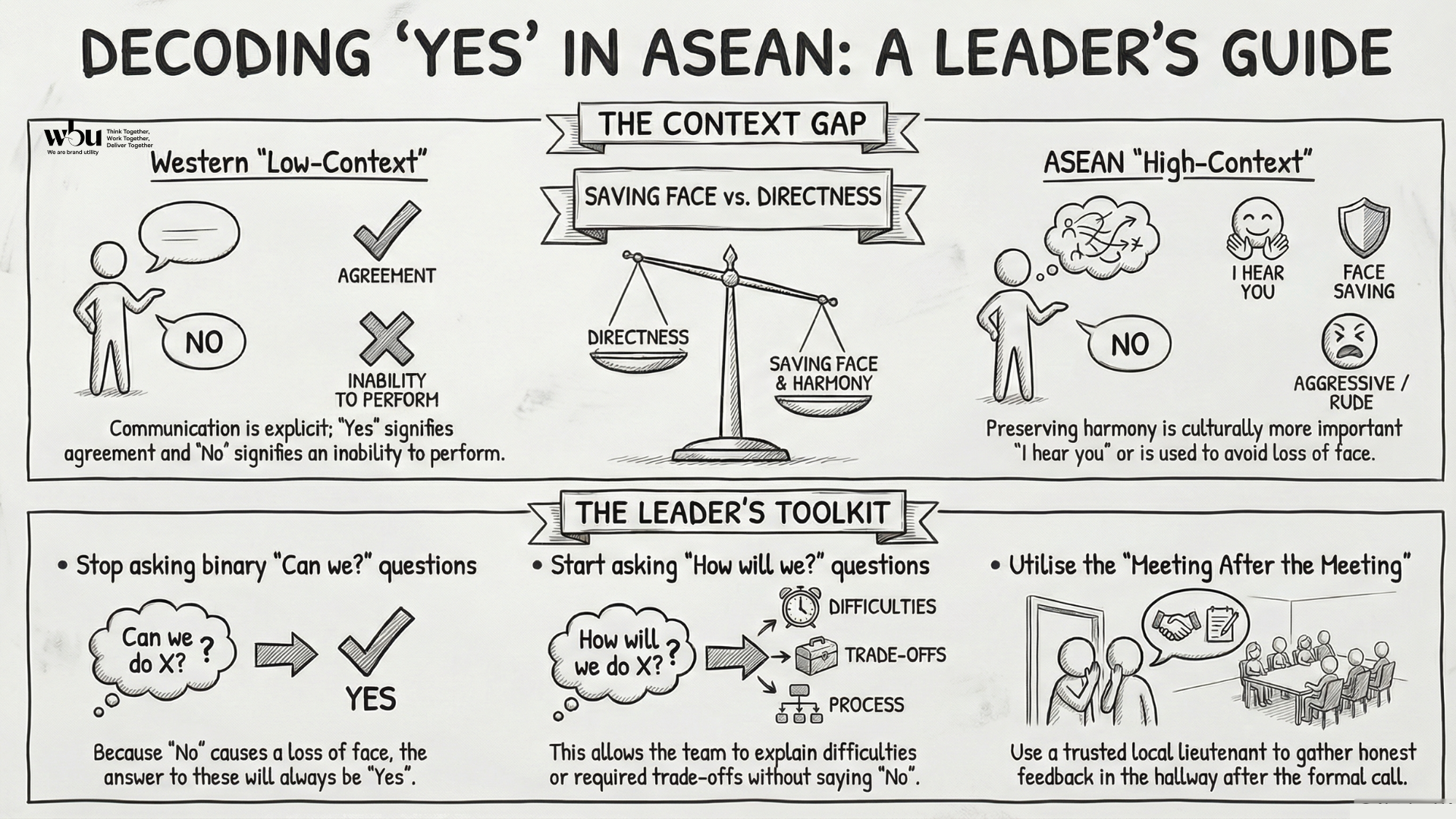
In High-Context cultures like Thailand, Indonesia, and Malaysia, communication is implicit. The meaning is in the context, not just the words. Saying a direct "No" to a boss causes the boss to lose face. It is considered rude and aggressive. So, "Yes" often means: "I hear you," or "I understand you want this," or "I will try my best, even though it is impossible."
Low-Context vs. High-Context Cultures
- The West (Low-Context): Communication is explicit. "Yes" means "I agree and I will do it." "No" means "I cannot do it."
- ASEAN (High-Context): Communication is implicit. The meaning is in the context, not just the words. In many Asian cultures, saying a direct "No" to a boss causes the boss to lose face. It is considered rude and aggressive.
When your AI tools summarise these meetings, they enforce a Western, low-context narrative that overrides the cultural reality. This is a direct hit to your Narrative Autonomy—the ability to know the actual truth of your operations.
How do you fix this? You must adapt your leadership style to bypass the algorithm's bias.
How to Fix This
You cannot force your team to become Low-Context. You must adapt your leadership style.
- Ask a lesser number of Binary Questions: Never ask "Can you do this?" The answer will always be yes.
- Ask "How" Questions: Ask "How will we achieve this timeline?" or "What other projects will we need to pause to hit this date?" This allows the team to explain the difficulties without saying "No."
- Use the "Meeting After the Meeting": In high-hierarchy cultures, the real truth is rarely spoken in the main boardroom. It is spoken in the hallway afterwards. Have a trusted local lieutenant who can give you the real feedback 15 minutes after the call ends.
Don't let a low-context digital summary dictate your regional strategy. Decode the context, protect your Narrative Autonomy, and do not lead with a transcript.