
Why Public Data Pollutes Enterprise AI Models
Aug 25, 2026, 12:00:00 PM • Written by: We are Brand Utility
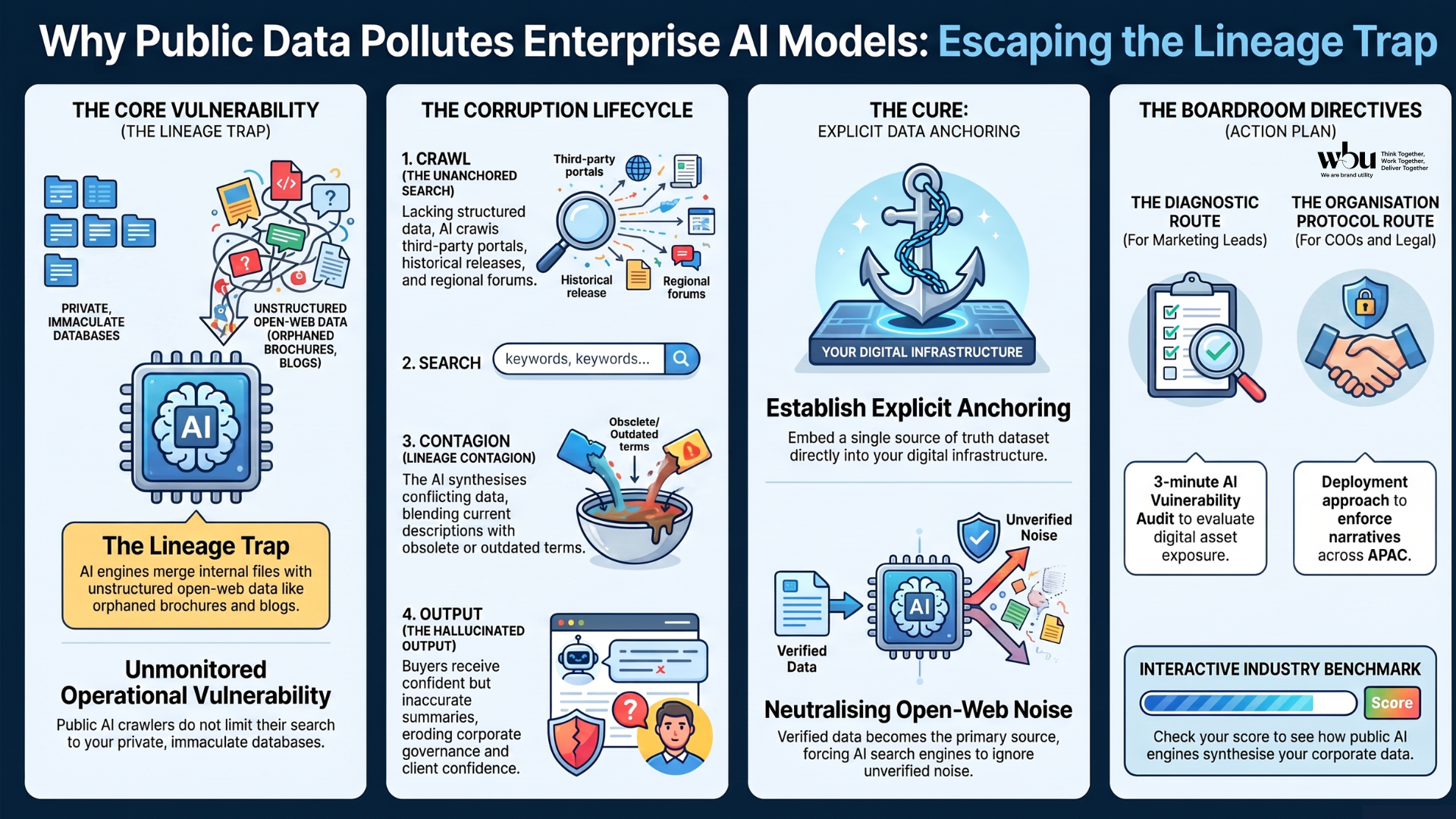
When operational leaders evaluate how artificial intelligence affects their business, most focus on internal software tools: enterprise search agents, customer support bots, or automated workflow assistants.
To power these tools, IT departments can implement Retrieval-Augmented Generation (RAG)—a technical method that allows AI models to pull fresh information from external web sources to answer user questions.
However, this creates an unmonitored operational vulnerability known as The Lineage Trap.
Even if your internal databases, customer relationship management (CRM) software, and enterprise files are immaculate, public AI crawlers do not limit their search to private servers. When enterprise AI search agents evaluate your firm, they combine internal files with unstructured open-web data.
If your primary domain lacks structured data, public AI models ingest orphaned partner brochures, historical blog posts, and regional forum comments—contaminating the data lineage of the very answers delivered to your clients and partners.
At We Are Brand Utility (WaBU), we help enterprise leaders secure their data lineage before buyer trust is compromised by AI drift.
Understanding How Data Lineage Corrupts AI Search
AI models do not verify historical context or check publication dates the way human researchers do. They evaluate statistical probability and pattern recency.
Consider how unanchored public data creates information pollution:
- The Retrieval Crawl: A prospective buyer or enterprise client uses an AI search tool to verify your operational capabilities, SLA guarantees, or compliance status.
- The Unanchored Search: The AI model searches public web indices. Finding no structured information on your website, it broadens its scope to third-party portals, historical press releases, and regional forums.
- Lineage Contagion: The AI synthesizes conflicting data points—combining a current service description with an obsolete 2021 fee structure or outdated warranty term.
- The Hallucinated Output: The buyer receives a confident, polished AI summary that misquotes your operational reality.
When this occurs, telling a prospective buyer that "the external search tool made a mistake" does not repair lost confidence. To a client, inaccurate data reflects poorly on corporate governance.
Securing Data Lineage
Solving the Lineage Trap does not require rebuilding internal IT infrastructure or locking down marketing web pages.
Instead, operational teams must establish explicit anchoring. By embedding a single source of truth dataset directly into your digital infrastructure, you establish an unambiguous baseline for search crawlers.
When public or enterprise AI engines query your brand data, they ingest your verified date as the primary source, neutralising unverified web noise before it enters the data pipeline.
Evaluate Your Data Lineage - Check Your Score on our Interactive Benchmark Tool.
Discover how public AI search engines synthesize your corporate data across regional markets, and ensure your enterprise facts remain 100% verified.
The Boardroom Directives
The Diagnostic Route
Unsure if your regional digital assets leave your brand vulnerable to AI Hallucinations and drift? Take our 3-minute AI Vulnerability Audit to evaluate your risk and readiness.
The Organisation Protocol Route
If your organisation is scaling operations across APAC and requires support on your digital subject or narrative enforcement, access the full deployment approach presentation.