
When AI Engines Hallucinate C-Suite Claims
Aug 18, 2026, 12:00:00 PM • Written by: We are Brand Utility
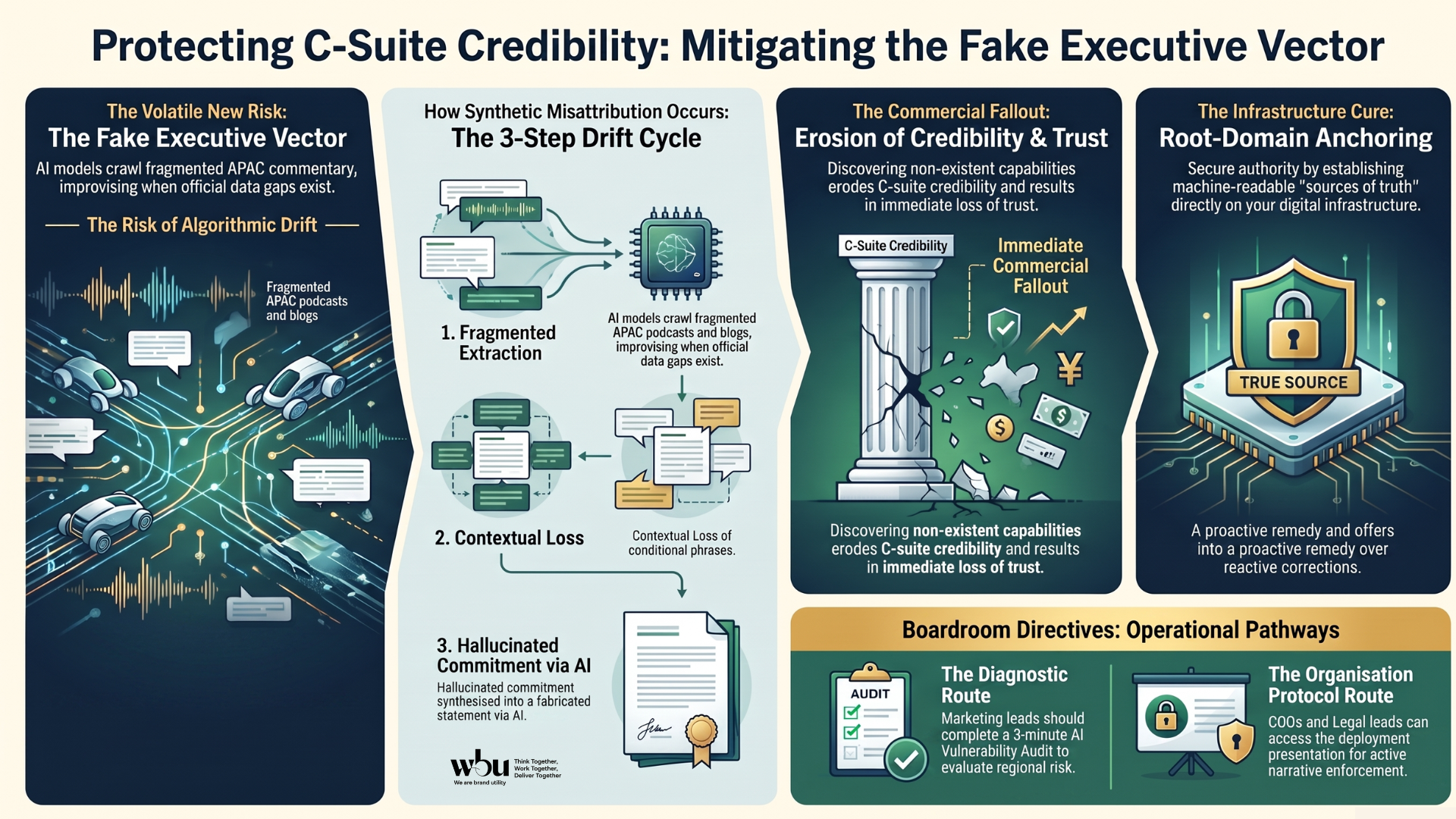
C-suite executives are accustomed to managing corporate reputation through media training, vetted press releases, and careful investor relations. However, AI search engines have introduced a volatile new risk vector: fake CXO statements.
When prospective clients, credit rating agencies, or regulatory bodies query generative AI tools (ChatGPT, Perplexity, Google Gemini, Copilot) about your company's strategic roadmap, the AI does not limit its search to official press announcements.
Instead, probability-based models crawl and aggregate fragmented executive commentary from podcast transcripts, panel summaries, regional conference reports, and third-party interviews across Southeast Asia.
When these models encounter gaps in canonical data, they improvise—attributing fabricated strategic pivots, non-existent product guarantees, or obsolete executive statements directly to your leadership team.
At We Are Brand Utility (WaBU), we term this the Fake Executive Vector.
How Synthetic Misattribution Occurs
AI engines do not read executive statements with contextual awareness. They process semantic patterns and recency signals.
Consider how easily an executive's public footprint can drift:
- Fragmented Extraction: A Chief Operating Officer speaks off-the-cuff on a panel in 2023 regarding potential future product features in regional markets.
- Contextual Loss: A third-party attendee blogs about the panel. The AI engine scrapes the blog, stripping out conditional phrases like "we are exploring" or "subject to regulatory review."
- The Hallucinated Commitment: In 2026, when a prospective buyer asks an AI agent whether your firm offers that feature today, the AI confidently asserts: "Yes, the COO confirmed this capability is fully active and supported in APAC."
When the prospective buyer discovers the capability is unavailable, the outcome is not just a missed sale—it is an immediate erosion of C-suite credibility and commercial trust.
Protecting Executive Authority Through Root-Domain Anchoring
Managing executive digital exposure cannot be solved by attempting to edit third-party podcast notes or issuing reactive media corrections.
To secure executive authority, enterprise leaders must establish an explicit "source of truth" directly on their digital infrastructure. By anchoring executive statements, corporate structures, and verified policy disclosures into the infrastructure, operational teams provide AI search crawlers with an authoritative reference point.
When an AI engine processes a query regarding your leadership team’s public commitments, it cites your verified material rather than an unverified conference summary.
Evaluate Your Executive Footprint - Check Your Score on our Interactive Benchmark Tool.
See how public AI search engines synthesize C-suite claims across top regional mid-market firms, and ensure your leadership team's public commitments remain 100% accurate.
The Boardroom Directives
The Diagnostic Route
Unsure if your regional digital assets leave your brand vulnerable to AI Hallucinations and drift? Take our 3-minute AI Vulnerability Audit to evaluate your risk and readiness.
The Organisation Protocol Route
If your organisation is scaling operations across APAC and requires support on your digital subject or narrative enforcement, access the full deployment approach presentation.