
Why is Clarity important for Financial Products and InsurTech
Sep 29, 2026, 10:00:00 AM • Written by: We are Brand Utility
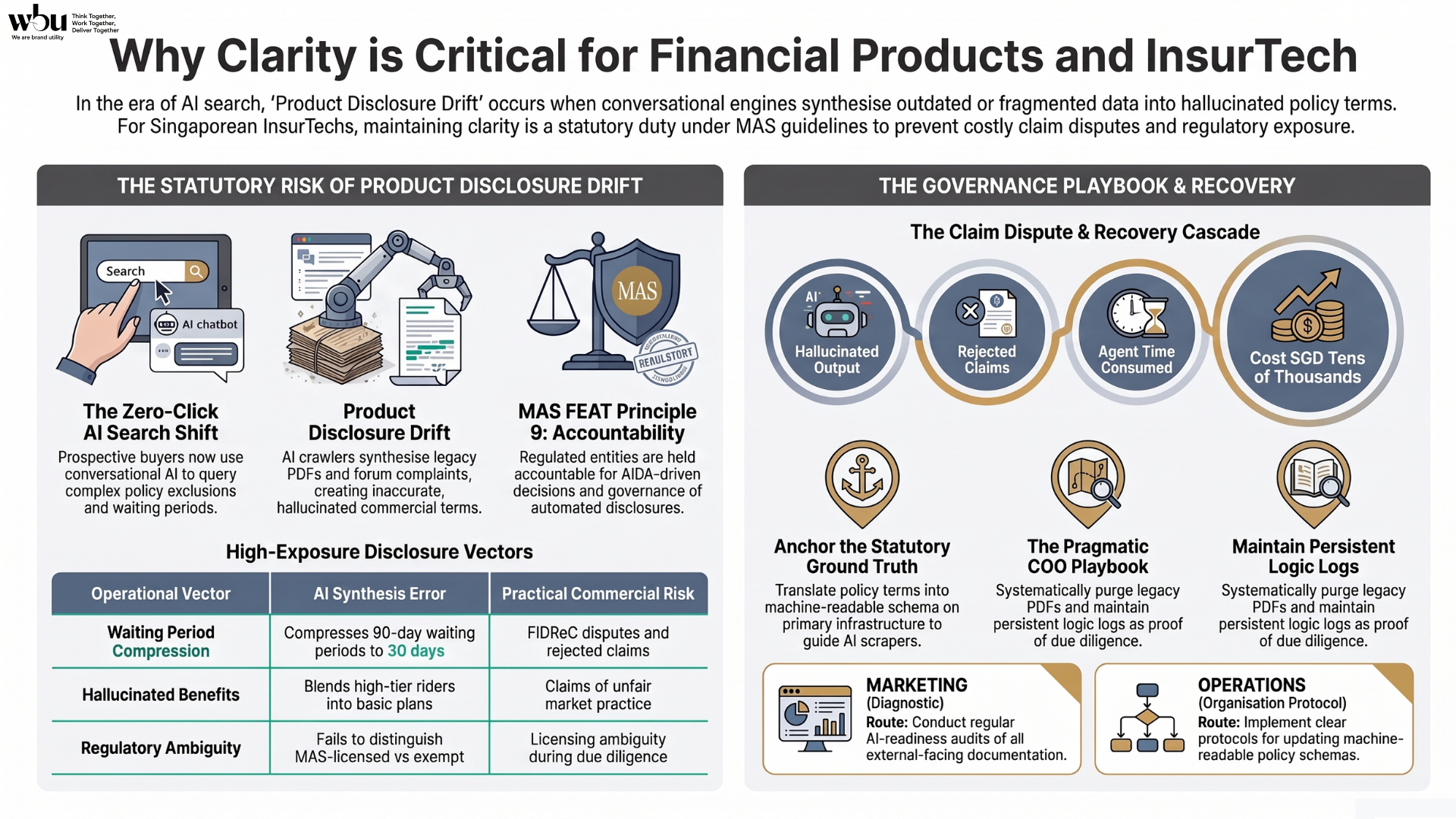
In consumer and commercial insurance, clarity is not merely an operational goal—it is a statutory obligation.
When a prospective policyholder evaluates health coverage, travel protection, or commercial cyber liability, the line between an accurate representation and an unlawful misstatement often comes down to a few critical words in an exclusion clause.
Over the past two years, digital acquisition models across Southeast Asia have shifted.
Prospective policyholders and corporate finance/procurement teams are no longer relying solely on human brokers or reading 40-page Product Summaries.
Instead, prospective buyers increasingly prompt conversational search tools—such as ChatGPT, Perplexity, and Microsoft Copilot:
-
"Does Policy X cover pre-existing respiratory conditions after a 30-day waiting period in Singapore?"
-
"What is the exact critical illness definition and survival period under Insurer Y’s signature plan?"
-
"Are cross-border cyber extortion claims covered under Supplier Z’s standard SME policy?"
When autonomous search engines answer these queries, they do not read policy wording with legal discernment. They ingest fragmented data across the open web—including legacy marketing brochures, expired promotional riders, and third-party aggregator forums.
When probabilistic engines synthesise this material, they frequently hallucinate commercial terms.
In digital financial services, this is Product Disclosure Drift.
The Regulatory Context: Understanding Institutional Duty in Singapore
Within Singapore’s regulatory environment, financial institutions operate under strict expectations regarding how their offerings are presented to the public.
The Monetary Authority of Singapore (MAS) has established explicit regulatory markers through its Guidelines on Standards of Conduct for Marketing and Distribution Activities. MAS states unequivocally that financial institutions must:
"Ensure that all marketing materials are clear, fair, and not misleading, and contain disclosures that are necessary to enable customers to make informed decisions."
Furthermore, under the MAS Principles to Promote Fairness, Ethics, Accountability and Transparency (FEAT) in the Use of AI and Data Analytics, the regulator outlines the principle of Accountability (Principle 9):
"AIDA-driven decisions are held to account. Regulated entities should ensure that internal governance frameworks, including accountability structures, are in place to address the risks of AIDA-driven decision-making."
While regulators acknowledge that an insurer does not directly control third-party search algorithms, statutory compliance becomes precarious when an institution allows conflicting, outdated disclosures to circulate freely on public channels without an established operational record of verification.
The Three High-Exposure Disclosure Vectors in InsurTech
Our diagnostic evaluations across regional digital insurers identify three frequent areas of exposure:
Operational Disclosure Vector |
How Public AI Engines Synthesise It |
Practical Commercial Risk |
Waiting Period Compression |
Compresses a statutory 90-day waiting period for critical illness down to 30 days based on legacy rider blogs. |
Policyholder files early claim; claim rejected; triggers formal FIDReC dispute and reputation damage. |
Hallucinated Benefit Inclusions |
Blends high-tier rider benefits with basic plan summaries, asserting experimental treatments are covered. |
Buyer enters contract under false premises, raising claims of unfair market practice. |
Regulatory Scope Confusion |
Fails to distinguish between direct MAS-licensed insurance and exempt marketplace distribution. |
Creates statutory licensing ambiguity during institutional partner or investor due diligence. |
This is how a situation cascades and your customer or accounts team becomes tangled in a week-long recovery cycle that does not really solve the problem:
|
This is happening |
Contributing factors |
|
Currently on the internet |
|
|
User runs an AI search about a policy |
AI Search platform ingests conflicting web sources including first and third-party information |
|
AI Search shares a hallucinated output regarding a policy the user searched/queried about |
|
|
Prospective Buyer purchases a policy through the insurer’s digital shop; becomes a policyholder |
Policyholder onboards, accesses dashboard, downloads and saves policy documents |
|
An incident the policy covers happens to the policyholder |
Policyholder submits a claim |
|
Policyholder’s claim is rejected for reasons |
|
The Limits of Certainty: A Pragmatic Approach for COOs
We cannot guarantee that public AI platforms will interpret complex underwriting logic with 100% legal precision on every single prompt.
Anyone claiming absolute technical control over external large language models misunderstands the probabilistic nature of the technology.
However, operational leaders can establish qualitative road markers that significantly reduce model uncertainty:
1. Retire Orphaned Disclosures: Systematically identify and purge unindexed, legacy product summary PDFs that remain cached on regional distributor networks.
2. Infrastructure and Owned Channel Anchoring: Translate policy exclusions, definitions, and waiting periods into structured, machine-readable formats hosted directly within your core digital infrastructure. When AI scrapers evaluate your terms, they encounter authoritative, unambiguous disclosures on owned channels.
3. Establish Persistent Logic Logging: Maintain continuous records of what public models are stating about your policy terms, documenting corrective actions as defensible proof of due diligence.
Managing AI product misrepresentation is not an abstract technology debate; it is an immediate market conduct priority. InsurTech leaders who treat digital disclosures as governed infrastructure protect both customer trust and their regulatory standing.
Secure Your Digital Footprint: Apply for an Executive Briefing
Building sovereign digital infrastructure protects sales pipeline velocity, maintains customer trust, and secures board safe harbour.
Take control of your brand's digital presence with two practical starting points:
- Top-of-Funnel Risk Scoring: Use our Interactive Industry Benchmark Tool to evaluate baseline hallucination rates across your sector and model your estimated revenue leakage using our updated calculation formula.
- Internal Governance Readiness: Complete the 10-Question AI Vulnerability Diagnostic to assess how well your organisation monitors and resolves public AI model drift.
For executive teams seeking a direct, peer-level discussion, we regularly host small, private Executive Briefings (capped at 8 CXOs or Leads per session) in Singapore under the Chatham House Rule.
Connect with us for an invitation to our next Executive Briefing or submit your organisation for an asynchronous Digital Risk Snapshot.
The Boardroom Directives
The Diagnostic Route
Unsure if your regional digital assets leave your brand vulnerable to AI Hallucinations and drift? Take our 3-minute AI Vulnerability Audit to evaluate your risk and readiness.
The Organisation Protocol Route
If your organisation is entering or scaling operations across APAC and want to understand how hallucinations are impacting your GTM and revenue pipeline, use our 5 sector, 50-company benchmark calculator to aid your decision-making.