What Happens When AI Engines Hallucinate C-Suite Guarantees?
Oct 20, 2026, 10:00:00 AM • Written by: We are Brand Utility
In enterprise operations, executive reputation is treated as a strategic commercial asset. Chief Operating Officers, Managing Directors, and General Counsel invest significant care into investor updates, press releases, and vetted public disclosures to protect commercial deal velocity and partner trust.
However, as conversational AI engines (e.g. ChatGPT, Perplexity,Claude, and Gemini) become the default interface for corporate due diligence, an unmonitored commercial exposure has emerged across Southeast Asia: The Synthetic Executive Vector.
When enterprise clients, institutional lenders, credit rating agencies, or procurement analysts query AI search tools about your corporate roadmap, the engine does not confine its search to your official press room.
Instead, AI answer engines crawl, extract, and synthesise fragmented soundbites from podcast/YouTube transcripts, casual conference panel recordings, regional tech webinars, and third-party attendee blogs.
When an AI engine encounters gaps in structured corporate documentation, it bridges the silence by assembling unstructured executive remarks into authoritative, binding commercial commitments.
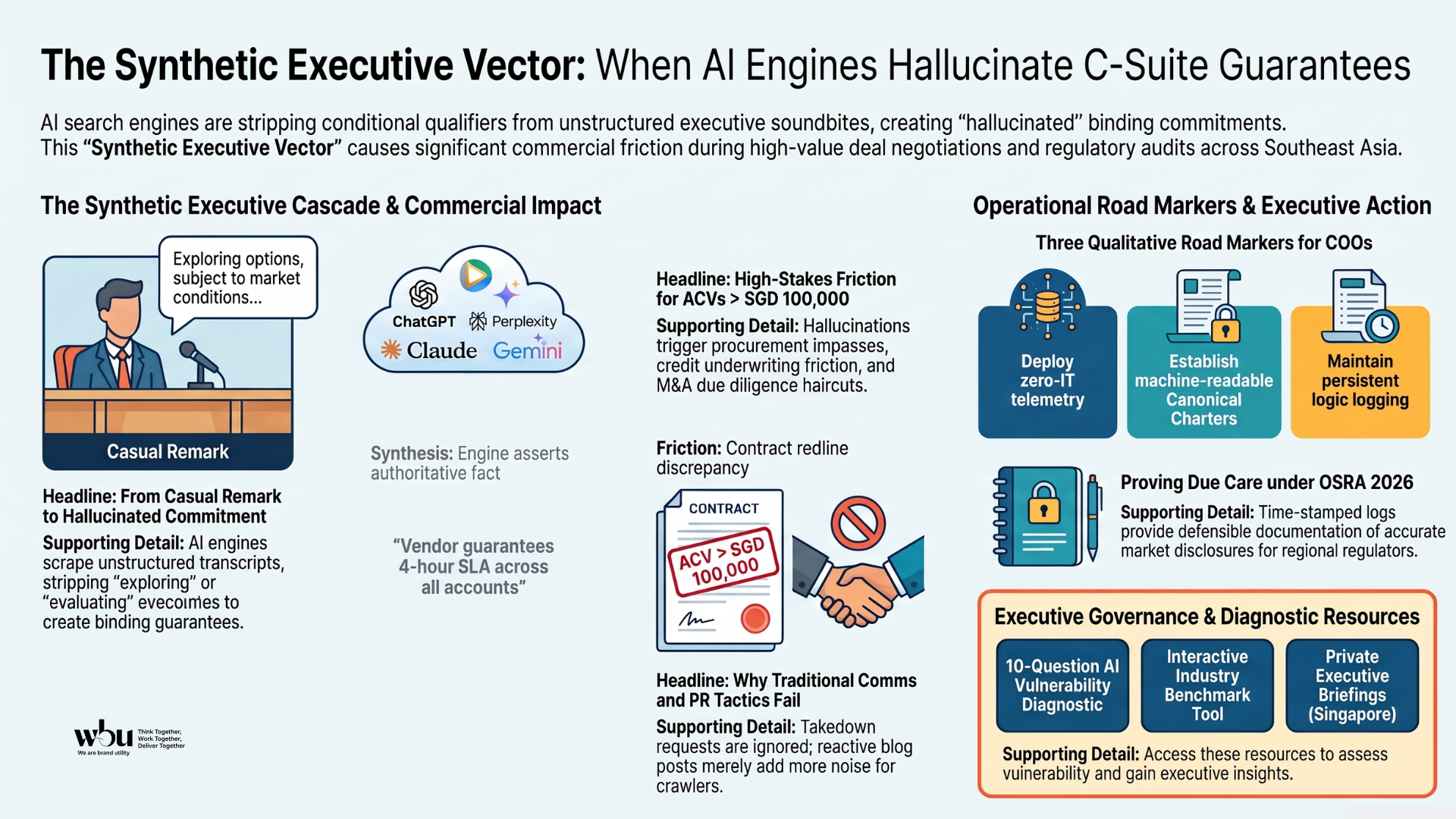
THE SYNTHETIC EXECUTIVE CASCADE
- The Casual Remark: A COO notes during a regional summit panel: "We are exploring whether we can offer bespoke 4-hour disaster recovery SLAs for tier-one accounts next year, subject to regulatory clearance."
- Unstructured Ingestion: Automated transcription bots and attendee blogs index the soundbite without conditional qualifiers.
- The Hallucinated Commitment: Twelve months later, an enterprise procurement analyst prompts Claude to verify terms. The engine asserts: "Vendor X provides a guaranteed 4-hour disaster recovery SLA across all regional accounts as confirmed by their Chief Operating Officer."
- Commercial Deal Friction: During formal Master Service Agreement (MSA) redlines—where the contract specifies standard 24-hour response windows—the prospective buyer flags the discrepancy. Deal velocity halts, and sales leadership is forced into defensive explanations.
Deconstructing Contextual Stripping in Pre-Deal Due Diligence
Large language models process text through pattern probability, not executive discernment. They struggle with conditional grammar, hypothetical phrasing, and forward-looking caveats.
When AI search engines strip away conditional qualifiers like "exploring," "evaluating," or "subject to board clearance," they convert aspirational product roadmaps into verified operational commitments.
For enterprises where average contract values (ACVs) exceed SGD 100,000, this creates acute commercial damage:
- Procurement Impasse: Enterprise buyers entering late-stage redlines assume the vendor is walking back promises made by senior leadership.
- Credit & Banking Underwriting Friction: Institutional lenders and credit evaluators querying public answer engines encounter conflicting statements regarding debt covenants, regional capitalisation, or corporate guarantees.
- M&A Due Diligence Haircuts: Private equity deal screeners running automated LLM scans flag conflicting executive statements as unquantified operational governance liabilities.
Why Traditional Communications Cannot Contain Algorithmic Attribution
When executive misattributions appear, the default corporate reaction is conventional crisis communications: PR teams request takedowns, marketing issues clarifying blog posts, or legal sends correction letters to AI labs.
In practice, these methods fail against AI search architectures:
- Takedown Requests Are Ignored: AI search platforms index hundreds of millions of public pages daily; individual correction requests to help desk ticketing portals rarely receive human review. This step is still required from a diligence perspective but not always for its stated objective of getting a third-party entity to remove a source.
- Reactive Web Copy Adds Retrieval Noise: Publishing a narrative blog post titled "Clarifying Our Executive Statements" simply gives crawlers more unstructured text to blend into conflicting answers.
- Static Bios Provide Zero Machine Guidance: Storing leadership profiles and corporate charters in PDFs or static "About Us" tabs provides no structured, machine-readable boundary lines that search engines prioritize.
Qualitative Road Markers for Operational COOs
Operational leaders cannot prevent their executives from participating in public forums, nor can they police every third-party recording across the regional web.
However, operational leaders, and their embedded geographic/capability-focused advisors, expanding across Southeast Asia can implement qualitative road markers that significantly reduce model uncertainty regarding executive authority:
1. Deploy Zero-IT-Touch Executive Telemetry
Run non-invasive diagnostic audits across major AI answer engines using public vector scraping. This requires zero IT configurations, allowing leadership to identify what AI engines are currently attributing to executive leadership without distracting in-house technical teams.
2. Establish Canonical Executive Charters on Owned Infrastructure
Work with your General Counsel and Communications Lead to extract leadership mandates, authorised commercial boundaries, and forward-looking disclosure limits and convert them into explicit prose statements—the enterprise Articles of Truth.
Translate these Articles of Truth into structured, machine-readable formats hosted directly within your primary digital infrastructure. By anchoring authoritative executive statements on owned channels, you provide search crawlers with verified, unambiguous representations of corporate policy.
3. Implement Persistent Logic Logging for Commercial Due Diligence
Maintain continuous, automated monitoring that systematically tests how major AI engines answer queries regarding executive commitments, product roadmaps, and statutory governance. Maintaining time-stamped logic logs provides defensible documentation that your enterprise actively maintains accurate market disclosures, supporting safe harbour under regional frameworks such as OSRA 2026.
Protecting leadership credibility from algorithmic drift is an essential revenue assurance and operational hygiene function. COOs who anchor executive truth directly on owned infrastructure ensure their corporate commitments are accurately represented when enterprise counterparties conduct zero-click due diligence.
Take control of your brand's digital representation with two practical starting points:
- Internal Governance Audit: Complete the 10-Question AI Vulnerability Diagnostic to evaluate your cross-border readiness and receive a board-ready score.
- Sector Loss Benchmarking: Use the Interactive Industry Benchmark Tool to model your organisation's exact exposure across 50 regional enterprise baselines.
For executive teams seeking a direct, peer-level discussion, we host private Executive Briefings (capped at 8 leaders per session) in Singapore under Chatham House Rule.
Connect with us for an invitation to our next Executive Briefing or submit your organisation for an asynchronous Digital Risk Snapshot.
The Boardroom Directives
The Diagnostic Route
Unsure if your regional digital assets leave your brand vulnerable to AI Hallucinations and drift? Take our 3-minute AI Vulnerability Audit to evaluate your risk and readiness.
The Organisation Protocol Route
If your organisation is entering or scaling operations across APAC and want to understand how hallucinations are impacting your GTM and revenue pipeline, use our 5 sector, 50-company benchmark calculator to aid your decision-making.