
What 5 ASEAN-Based COOs Revealed About Operational AI Risk
Sep 22, 2026, 10:30:00 AM • Written by: We are Brand Utility
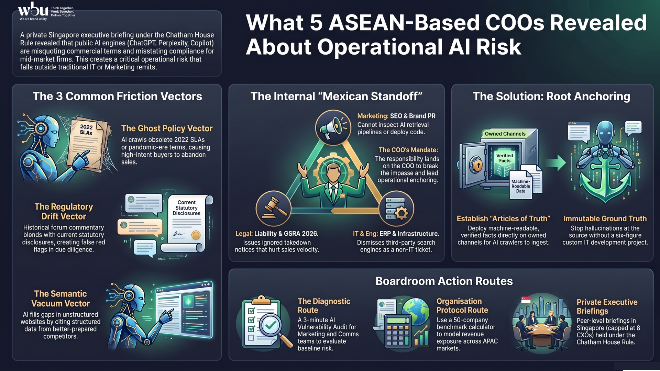
We Are Brand Utility convened a private, closed-door Micro-Executive Briefing under the Chatham House Rule with five COOs.
They represented mid-market enterprises operating across Southeast Asia—spanning wealth advisory, B2B logistics, digital financial infrastructure, and regional hospitality.
None of these leaders had joined the session to debate artificial intelligence philosophy, discuss futuristic robot agents, or learn technical coding syntax. Each of them arrived because of a shared, concrete commercial problem:
"Prospective clients, banking partners, and nvestors are querying ChatGPT, Perplexity, and Copilot about our business—and the AI engines are returning answers that contradict our commercial terms, invent non-existent fees, or misstate our compliance standing."
When senior operational leaders discuss generative AI in private, the tone changes completely from public marketing optimism to clinical risk management.
Here is what emerged when five ASEAN-based COOs compared notes on the operational reality of public AI search representation.
The Three Common Friction Vectors
Across all five organisations, public AI engines were not failing because of malicious attacks or competitor sabotage. They were failing because large language models (LLMs) crawl unanchored, historical open-web data and synthesise it with equal authority against current operational reality.
The five COOs identified three identical failure vectors in their respective portfolios:
|
Operational Risk Vector |
How the AI Search Tool Manifests It |
Business Consequence |
|
1. The Ghost Policy Vector |
Pulls pandemic-era cancellation terms, archived fee sheets, or obsolete 2022 SLAs from third-party blogs. |
High-intent buyers abandon checkout or sales calls, assuming rigid, uncompetitive commercial terms. |
|
2. The Regulatory Drift Vector |
Blends forum commentary about historical license applications with current statutory licensing disclosures. |
Creates false red flags during institutional due diligence or client compliance onboarding. |
|
3. The Semantic Vacuum Vector |
Improvised answers fill gaps where the company’s website lacks machine-readable data on key client questions. |
AI search engines cite regional competitors who provide structured, unambiguous answers. |
The Internal "Mexican Standoff"
The most revealing segment of the discussion centred on why internal enterprise teams fail to solve this problem organically. Every COO around the table described an identical cross-functional impasse:
- Marketing & Communications: Views public AI tools through the lens of SEO keywords and social listening. They publish blog posts and press releases, but lack the technical capabilities to inspect retrieval pipelines or deploy machine-readable content.
- Legal & General Counsel: Identifies public misrepresentation as a grave statutory liability under emerging frameworks like Singapore's Online Safety Regulations (OSRA 2026) and MAS AI guidelines. Their default response is to demand heavy web disclaimers that hurt sales conversion, while issuing takedown notices that search platforms ignore.
- Engineering & IT: Focuses strictly on core software product delivery, cybersecurity, and internal ERP/PMS systems. When asked to patch public search representation, engineering leadership responds: "Third-party search engines are an external marketing issue, not an IT infrastructure ticket."
When Legal demands total control, Marketing demands growth velocity, and IT declines ownership, the issue lands squarely on the desk of the Chief Operating Officer.
The Shift to Operational Anchoring
The consensus among our five participants was immediate: mid-market enterprises cannot afford to wait for search platforms to self-correct, nor can they allow cross-functional friction to delay action.
Solving public AI hallucinations does not require a six-figure custom IT development project. It requires Anchoring—establishing verified, machine-readable "Articles of Truth" directly on the company’s owned channels so that public AI crawlers ingest verified facts as immutable ground truth.
When your operational terms, SLAs, and compliance charters are structured directly into code, the AI engines stop guessing.
Secure Your Digital Footprint: Apply for an Executive Briefing
Building sovereign digital infrastructure protects sales pipeline velocity, maintains customer trust, and secures board safe harbour.
Take control of your brand's digital presence with two practical starting points:
- Top-of-Funnel Risk Scoring: Use our Interactive Industry Benchmark Tool to evaluate baseline hallucination rates across your sector and model your estimated revenue leakage using our updated calculation formula.
- Internal Governance Readiness: Complete the 10-Question AI Vulnerability Diagnostic to assess how well your organisation monitors and resolves public AI model drift.
For executive teams seeking a direct, peer-level discussion, we regularly host small, private Executive Briefings (capped at 8 CXOs or Leads per session) in Singapore under the Chatham House Rule.
Connect with us for an invitation to our next Executive Briefing or submit your organisation for an asynchronous Digital Risk Snapshot.
The Boardroom Directives
The Diagnostic Route
Unsure if your regional digital assets leave your brand vulnerable to AI Hallucinations and drift? Take our 3-minute AI Vulnerability Audit to evaluate your risk and readiness.
The Organisation Protocol Route
If your organisation is entering or scaling operations across APAC and want to understand how hallucinations are impacting your GTM and revenue pipeline, use our 5 sector, 50-company benchmark calculator to aid your decision-making.