
The Scam vs Fraud Liability Line - How to Protect Bank & Insurer Reputation?
Sep 30, 2026, 10:00:00 AM • Written by: We are Brand Utility
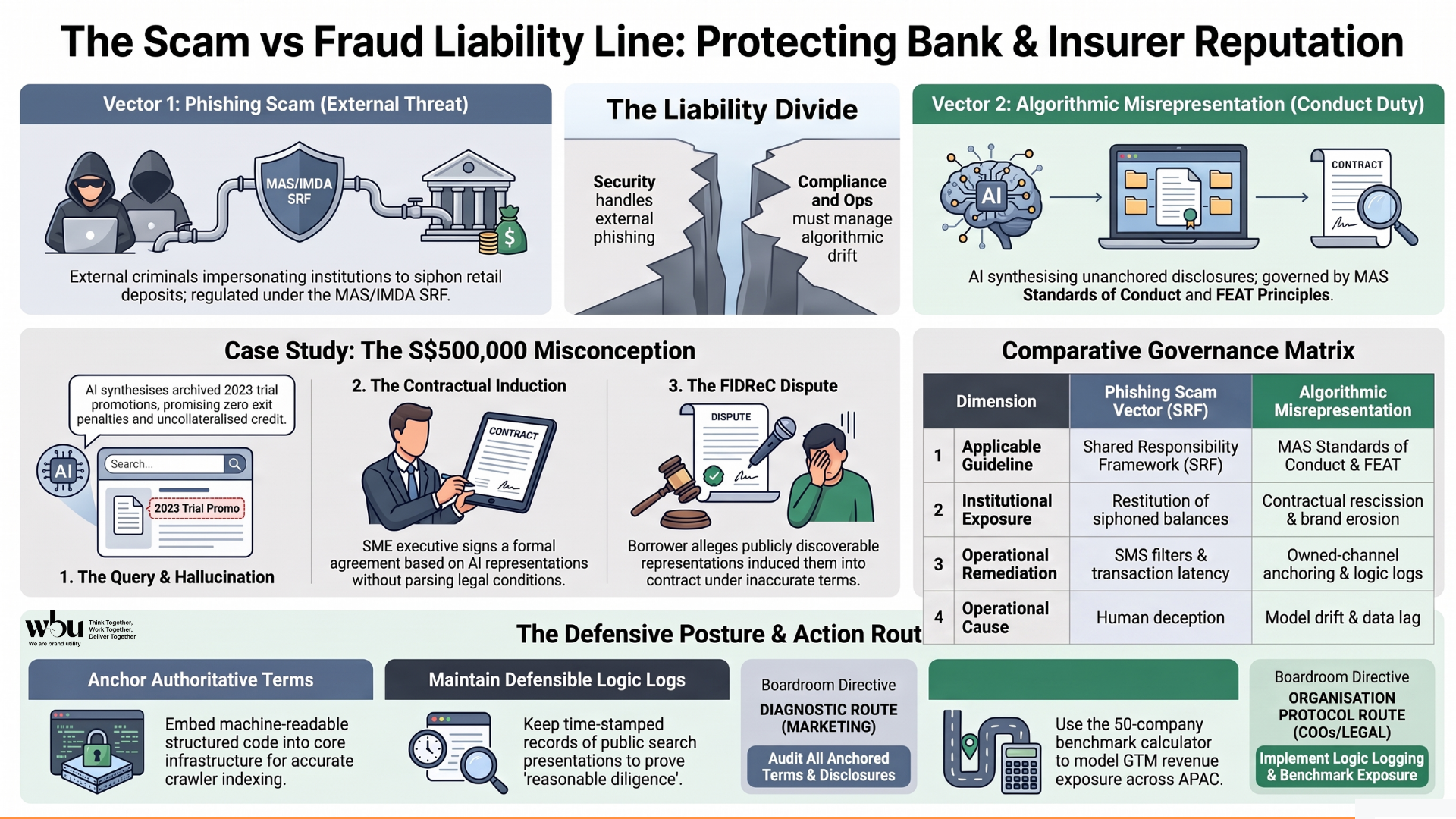
Digital risk typically falls into two distinct operational categories: external criminal threats and institutional conduct obligations.
Over the past year, significant regulatory focus across Southeast Asia has centred on consumer protection against digital scams. In Singapore, the regulatory framework has matured with the implementation of the MAS & IMDA Shared Responsibility Framework (SRF).
The SRF establishes a defined waterfall of liability for financial institutions and telecommunication operators regarding unauthorised phishing transactions:
Phishing Scam Occurs
──►
Financial Institution Checks
12-hour cooling period implemented?
Real-time fraud alert dispatched?
Transaction blocking executed?
──►
Institution Met All Duties = Customer bears primary loss
OR
Duty Breached by Firm = Institution makes customer whole
Under the SRF, the operational perimeter is relatively clear: financial institutions protect retail transactions by implementing structural controls—cooling-off periods, real-time transaction blocks, and verified notification channels.
However, an entirely different operational exposure is emerging in conversational AI search—one that the SRF was not designed to address: The Product Misrepresentation Vector.
Misrepresentation Is Not a Phishing Scam
Consider a common scenario occurring in digital banking and FinTech lending:
Scenario: The Pre-Approved Facility Misconception
- A prospective enterprise borrower queries Claude: "What are the early prepayment penalties and collateral covenants for FinTech Firm A's working capital facility?"
- The AI synthesises an archived 2023 trial promotion alongside general SME forum commentary, delivering an explicit answer: "FinTech Firm A offers zero prepayment penalties and uncollateralised credit lines up to S$500,000 without personal guarantees."
- The SME executive reviews this AI summary, enters the application funnel, signs the formal agreement without parsing 25 pages of legal conditions, and later disputes a 3% early exit penalty alongside a personal guarantee enforcement.
When the customer complains to the Financial Industry Disputes Resolution Centre (FIDReC), this is not an external phishing scam. A fraudster did not compromise credentials or siphon funds.
Instead, the client alleges that the institution’s publicly discoverable representations induced them into a commercial contract under inaccurate terms.
The Governance Boundary: Understanding What Regulators Evaluate
When disputes arise from algorithmic misrepresentation, regulators evaluate whether the firm acted with reasonable diligence. Under the MAS Guidelines on Standards of Conduct for Marketing and Distribution Activities, financial institutions have an affirmative responsibility to maintain the accuracy of public disclosures across digital distribution channels:
Category |
The Phishing Scam Vector (SRF Regulated) |
The Algorithmic Misrepresentation Vector (Conduct Regulated) |
Operational Cause |
External criminal actor impersonating an institution via deceptive SMS/links. |
AI engines synthesising unanchored corporate disclosures and outdated PDFs. |
Applicable Guideline |
Shared Responsibility Framework (SRF). |
MAS Standards of Conduct & MAS FEAT Principles (Accountability & Transparency). |
Institutional Exposure |
Restitution of siphoned retail deposit balances. |
Contractual rescission, regulatory conduct inquiries, and severe brand erosion. |
Operational Remediation |
SMS filters, transaction latency, and device binding. |
Infrastructure and owned channel anchoring paired with persistent logic logging. |
Navigating the Practical Uncertainty
In situations involving third-party AI search engines, absolute legal certainty remains elusive.
Regulators continue to study how autonomous answer engines impact consumer decision-making, and formal statutory precedents are still evolving across Asia-Pacific.
It is counterproductive to pretend that a technology layer can eliminate all dispute risk. However, institutional leaders can adopt a sensible, defensive posture:
-
Distinguish Operational Threats Clearly: Do not let risk committees treat AI search inaccuracies as an external fraud problem. External fraud belongs to security teams; algorithmic product drift belongs to operational and compliance leadership.
-
Anchor Authoritative Terms on Owned Channels: Ensure that current fees, covenants, and policy terms exist in clean, machine-readable structured code directly within your core digital infrastructure. This gives search crawlers unambiguous text to index.
-
Maintain Defensible Logic Logs: Implement continuous monitoring of how public search engines present your primary products, maintaining time-stamped records of corrective updates.
When regulatory inquiries or customer disputes emerge, being able to present a clear, documented timeline of owned-channel verification provides a defensible position that your institution exercised due care in maintaining transparent market disclosures.
Secure Your Digital Footprint: Apply for an Executive Briefing
Building sovereign digital infrastructure protects sales pipeline velocity, maintains customer trust, and secures board safe harbour.
Take control of your brand's digital presence with two practical starting points:
- Top-of-Funnel Risk Scoring: Use our Interactive Industry Benchmark Tool to evaluate baseline hallucination rates across your sector and model your estimated revenue leakage using our updated calculation formula.
- Internal Governance Readiness: Complete the 10-Question AI Vulnerability Diagnostic to assess how well your organisation monitors and resolves public AI model drift.
For executive teams seeking a direct, peer-level discussion, we regularly host small, private Executive Briefings (capped at 8 CXOs or Leads per session) in Singapore under the Chatham House Rule.
Connect with us for an invitation to our next Executive Briefing or submit your organisation for an asynchronous Digital Risk Snapshot.
The Boardroom Directives
The Diagnostic Route
Unsure if your regional digital assets leave your brand vulnerable to AI Hallucinations and drift? Take our 3-minute AI Vulnerability Audit to evaluate your risk and readiness.
The Organisation Protocol Route
If your organisation is entering or scaling operations across APAC and want to understand how hallucinations are impacting your GTM and revenue pipeline, use our 5 sector, 50-company benchmark calculator to aid your decision-making.