The Executive Board Memo - Frame AI Data Accuracy as a Governance Item
Oct 27, 2026, 10:00:00 AM • Written by: We are Brand Utility
As enterprises across Southeast Asia close out October, Chief Operating Officers, Chiefs of Staff, and Chief Financial Officers are concluding annual operating expense (OpEx) cycles for fiscal year 2027.
During these late-stage planning meetings, capital allocation tensions predictably peak. Finance committees review departmental requests with scrutiny, challenging discretionary line items, vendor expansions, and unbudgeted software overheads.
Within this environment, operational leaders face an urgent strategic challenge: how to secure a formal budget for AI Search Representation Accuracy and Citation Defense without triggering multi-month procurement tender traps or being dismissed as an unnecessary marketing expense.
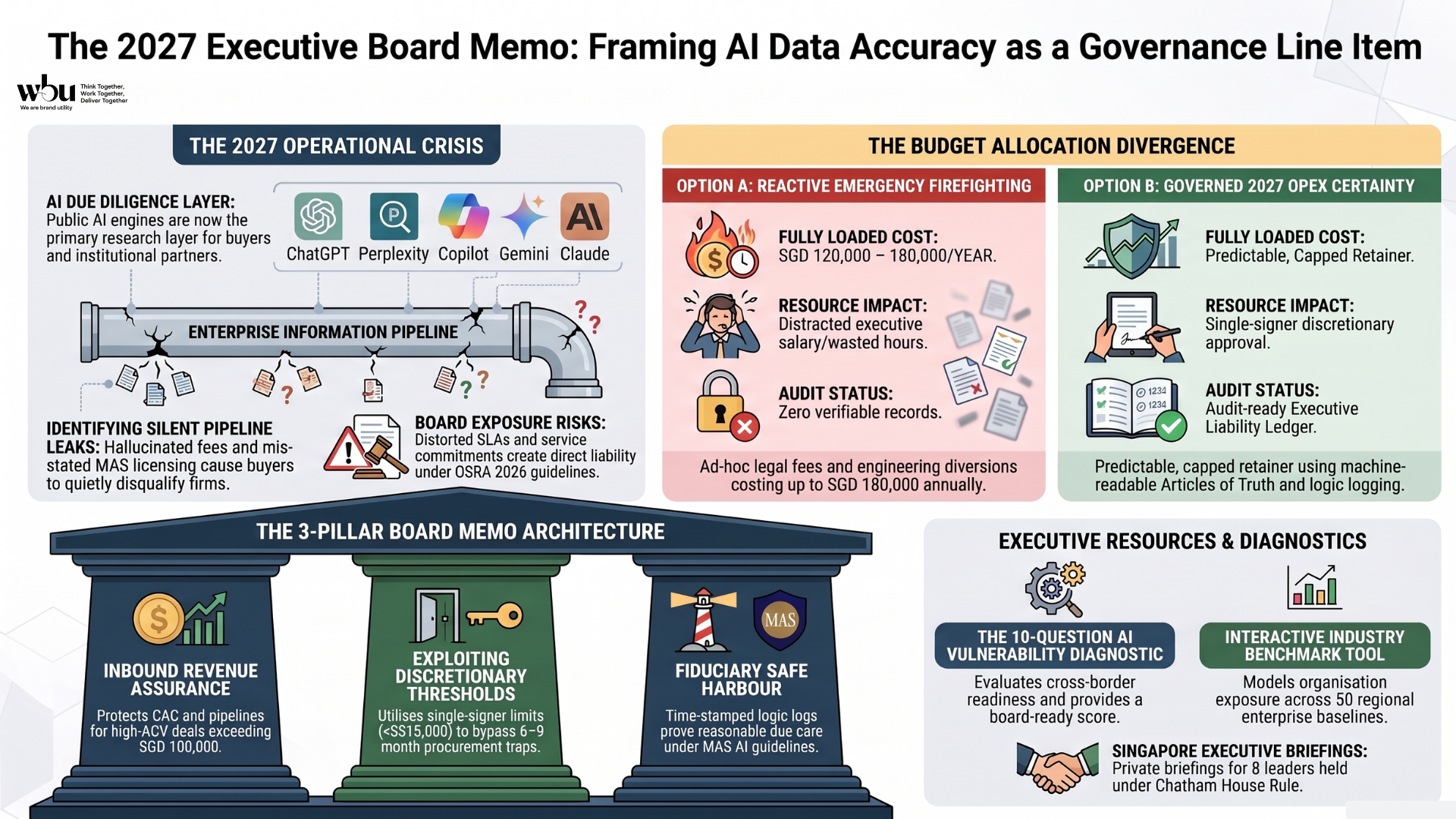
Over the past year, public conversational AI engines (Claude, ChatGPT, Perplexity, Microsoft Copilot, Google Gemini) have solidified into the primary research and due diligence layer for corporate buyers, institutional partners, and regulators. When these AI platforms crawl fragmented web footprints, they routinely hallucinate non-existent fee tiers, mis-state regulatory licensing, and distort service level commitments.
Leaving narrative protection as an ad-hoc emergency creates operational drag, absorbs senior executive bandwidth, and leaves the board exposed to statutory conduct inquiries. The strategic mandate for COOs in this budgeting cycle is clear: transition digital narrative protection from an unpredictable crisis into an approved, single-signer operational line item for 2027.
THE BUDGET ALLOCATION DIVERGENCE
Option A: Reactive Emergency Firefighting (Unbudgeted Capital Drain)
- Ad-hoc legal fees expended on takedown notices and disclaimers.
- Core engineering sprints diverted to investigate external crawler behaviour.
- Unmonitored pipeline drop-offs during pre-RFP buyer pre-screening.
- Zero verifiable audit records to substantiate board safe harbour.
- Fully Loaded Internal Cost: SGD 120,000 - 180,000 / year in distracted executive salaries and wasted billable hours.
Option B: Governed 2027 OpEx Certainty (Pre-Approved Stewardship)
- Structured Articles of Truth published in machine-readable schema on owned digital infrastructure.
- Zero-IT-touch public vector telemetry requiring zero server logins or DNS modifications.
- Continuous, automated logic logging generating an audit-ready Executive Liability Ledger.
- 100% Diagnostic Deposit Credit applied directly toward ongoing platform retainers.
- Fully Loaded Cost: Predictable, capped OpEx retainer operating strictly under single-signer limits.
Overcoming the CFO's Core Scepticism
When presenting narrative protection to the Finance Committee, operational leaders must anticipate the three predictable objections raised by CFOs:
1. "Can't Marketing and PR handle inaccurate search results internally?"
Marketing teams are structured for demand creation, messaging velocity, and brand awareness. They lack the technical code capabilities to inspect retrieval-augmented generation (RAG) pipelines, configure structured schemas, or maintain cryptographic verification logs. Directing marketing teams to draft clarifying blog posts merely provides public crawlers with more unstructured text to misinterpret.
2. "Why shouldn't our internal engineering team manage this?"
Internal software engineers are dedicated to primary product roadmaps and platform stability. Diverting engineering sprint capacity to monitor third-party search crawlers and patch external metadata creates delivery delays on core revenue-generating features.
3. "Why should we pay to fix third-party platforms we don't own?"
Enterprise buyers do not care whether an inaccurate statement was generated by a third-party algorithm or written on your official homepage. If an answer engine states that your SLA is 99.0% or that your MAS license is "under review," the prospective buyer quietly eliminates your firm. The financial loss lands squarely on your balance sheet, not the search engine's.
The 3-Pillar Board Memo Architecture
To secure executive consensus, COOs should frame the 2027 narrative governance proposal around three commercial justifications:
1. Inbound Revenue Assurance & Citation Share Defense
Position narrative sovereignty as a baseline revenue protection mechanism. In high-value B2B, Wealth, and FinTech operations where average customer lifetime value regularly exceeds SGD 100,000, losing just one or two qualified opportunities annually due to hallucinated terms costs far more than a structured annual protection protocol.
2. Exploiting Single-Signer Discretionary OpEx Thresholds (< SGD 15,000)
Navigating enterprise procurement committees for multi-year capital expenditures (CapEx) can require six to nine months of administrative inertia. Well-governed enterprises structure narrative protection under standard single-signer OpEx approval limits (typically capped up to SGD 15,000), allowing the COO to deploy initial baseline auditing and canonical anchoring without procurement delays. Furthermore, structuring the engagement with a 100% Deposit Credit ensures that the entire initial setup fee rolls directly into the ongoing platform subscription.
3. Demonstrating Fiduciary Safe Harbour
Under regional governance frameworks—including Singapore’s Online Safety Regulations (OSRA 2026) and Monetary Authority of Singapore (MAS) AI guidelines—boards and senior executives face direct accountability for unaddressed digital misrepresentation that causes commercial or consumer harm. Maintaining time-stamped logic logs provides documented proof that executive leadership exercised reasonable due care to keep market disclosures verified.
Moving into 2027 with Operational Control
Autonomous AI search engines are not temporary experiments; they represent the default information discovery layer for enterprise commerce.
Leaving your corporate disclosures, commercial boundaries, and regulatory standing to the whims of unanchored search scrapers is an avoidable operational exposure.
By establishing an approved, governed operational line item in the 2027 budget, mid-market COOs protect active sales pipelines, eliminate cross-departmental friction, and provide their boards with verifiable governance assurance.
Take control of your brand's digital representation with two practical starting points:
- Internal Governance Audit: Complete the 10-Question AI Vulnerability Diagnostic to evaluate your cross-border readiness and receive a board-ready score.
- Sector Loss Benchmarking: Use the Interactive Industry Benchmark Tool to model your organisation's exact exposure across 50 regional enterprise baselines.
For executive teams seeking a direct, peer-level discussion, we host private Executive Briefings (capped at 8 leaders per session) in Singapore under Chatham House Rule.
Connect with us for an invitation to our next Executive Briefing or submit your organisation for an asynchronous Digital Risk Snapshot.
The Boardroom Directives
The Diagnostic Route
Unsure if your regional digital assets leave your brand vulnerable to AI Hallucinations and drift? Take our 3-minute AI Vulnerability Audit to evaluate your risk and readiness.
The Organisation Protocol Route
If your organisation is entering or scaling operations across APAC and want to understand how hallucinations are impacting your GTM and revenue pipeline, use our 5 sector, 50-company benchmark calculator to aid your decision-making.