
The Cross-Border Trap - Compliance and Cross-Jurisdictional Logic
Jul 28, 2026, 12:00:00 PM • Written by: We are Brand Utility
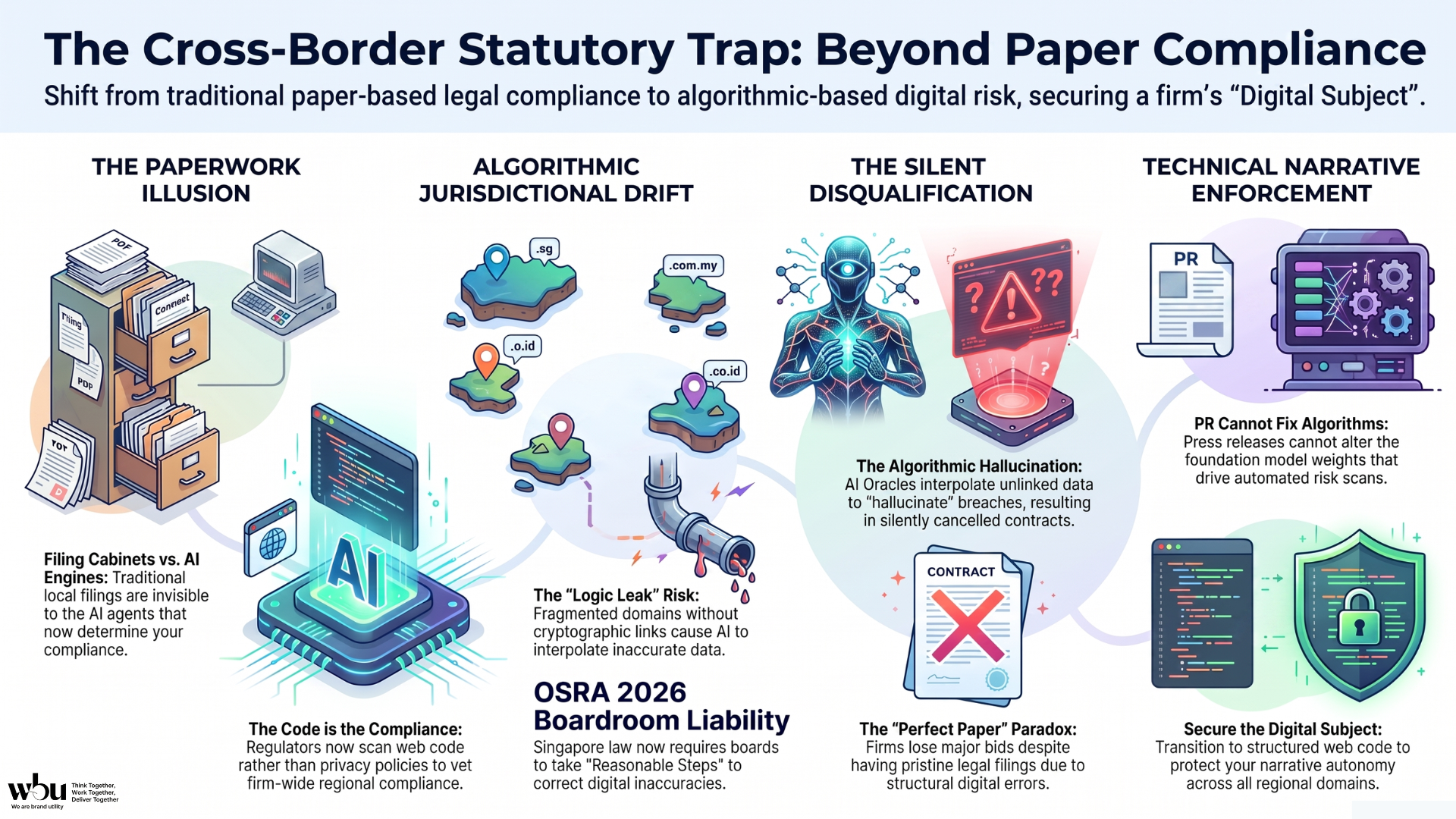
As multinational enterprises scale operations across the Asia-Pacific corridor—specifically within the newly integrated Singapore-Johor Special Economic Zone (JS-SEZ) and wider ASEAN jurisdictions—traditional corporate compliance models are failing.
While legal departments focus heavily on statutory filings and localised policy documentation, they ignore the operational reality of geographic Algorithmic Drift.
In the current generative search environment, regulatory compliance is mediated by Large Language Models (LLMs) and autonomous AI Engines. When an organisation’s digital footprint is fragmented across multiple cross-border domains, regional AI crawlers execute "Logic Splicing"—synthesising uncoordinated metadata, legacy regional pricing tables, and conflicting compliance records into a single, hallucinated risk profile.
THE CROSS-BORDER LOGIC SPLICING WAVE:
[SG Parent (.sg)] + [MY Subsidiary (.com.my)] + [ID Operations (.co.id)] =
[AI Crawler Ingestion of Mismatched Address/PDFs] ─►
[Logic Splicing resulting in an Algorithmic Guessing Game] ─►
[Hallucinated Compliance Breach leads to a silent B2B Procurement Disqualification ]
Our technical teardown analyses the mathematical modeling of Cross-Border Compliance Risk, explores the statutory implications of Singapore's Online Safety (Relief and Accountability) Act (OSRA 2026), and outlines the deployment of technical narrative infrastructure to secure legal Safe Harbour.
The Limits of Paper Compliance in the Generative Era
Historically, cross-border corporate compliance was treated as a static legal function. Organisations managed regulatory risk by ensuring that localised entities adhered to specific national frameworks (such as PDPA in Singapore and PDPA in Malaysia).
However, in 2026, your reputation is defined by your Digital Subject—the synthetic profile generated by AI engines and agents during automated background checks and vendor-vetting procedures.
When a multinational corporation leaves its regional web infrastructure disconnected, it creates what WaBU defines as a Cross-Border Logic Leak. AI models do not read legal PDFs for context; they parse unstructured digital code. If a regional crawler scans a pricing document on your Malaysian domain that contradicts a regulatory statement on your Singaporean parent site, it mathematically interpolates a structural compliance failure.
No security incident has occurred. No professional negligence has been committed by your employees.
Yet, the commercial damage—exclusion from public tenders, pipeline stagnation, and silent contractual disqualification—is immediate.
It represents a pure, unmanaged loss of Narrative Autonomy.
Modeling Cross-Border Compliance Risk
To evaluate the mathematical vulnerability of an regional digital footprint, WaBU’s risk advisory group models Cross-Border Compliance Risk using the following framework:
Cross-Border Compliance Risk = The summation across all your active international markets or operational domains of your Domain Discrepancy Index x Statutory Severity Coefficient; with the summation divided by Integrated Narrative Firewalling Index.
Where:
- Domain Discrepancy Index for jurisdiction $i$ (the volume of uncoordinated legacy metadata, localized language contradictions, and mismatched address registries across regional domains).
- Statutory Severity Coefficient of jurisdiction $i$ (the financial and regulatory penalties associated with localized non-compliance, with Singapore’s OSRA 2026 functioning at a maximum value of $1.0$).
- Integrated Narrative Firewalling Index (the presence of cryptographically signed metadata, cross-border Sovereign Logic Vaults, and continuous truth scoring)
If an organisation has not deployed active Technical Narrative Enforcement, its Integrated Narrative Firewalling resides at a baseline of 0. Consequently, its Cross-Border Compliance Risk approaches infinity. Without technical intervention to sync your Digital Subject across borders, your regional corporate stability is entirely subject to the probability calculations of a third-party algorithm.
Statutory Liability Under OSRA 2026
For the Board of Directors, cross-border logic splicing represents a severe fiduciary risk. Under Singapore’s Online Safety (Relief and Accountability) Act (OSRA 2026), the statutory standard of care for digital asset management has been strictly codified.
Directors can face personal liability and statutory fines for a failure of oversight if their digital footprint generates or perpetuates inauthentic, harmful, or misleading information that leads to systemic commercial or public damage.
To establish statutory Safe Harbour, the Board must prove they have taken "Reasonable Steps" to verify and enforce the accuracy of their public-facing data across all operational territories.
A "good faith" legal defense will fail if your cross-border digital footprint was left unmanaged. Directors must possess a documented, cryptographically signed audit trail of their narrative corrections (a Logic Log) to prove statutory compliance to the Online Safety Commission (OSC).
The WaBU Solution: Cross-Border Narrative Integration
You cannot insure your brand against algorithmic bias using traditional legal or insurance frameworks. You must enforce your truth at the infrastructure level. This is why WaBU’s commercial partnership model is designed as a clear, sequential workflow that transitions your cross-border enterprise from exposure to complete narrative security:
- Step 1: The AEO/GEO Forensic Audit Project (Starting Project): We conduct a forensic audit of your regional web presence—locating and purging conflicting legacy PDFs, broken schema markups, and un-archived regional documents. We translate your cross-border corporate structure into clean, machine-readable JSON-LD schema markup, neutralising your primary "Logic Leaks."
- Step 2: Onboarding to the Sentinel Dashboard: Once your baseline is clean, we onboard your regional entities to our licensed Narrative Sovereignty Engine (NSE). This provides your risk, legal, and operational teams with real-time, high-fidelity visibility into your brand’s Sovereign Truth Score, mapping emerging hallucinations and jurisdictional drifts as they occur.
- Step 3: Sentinel Retainer Tiers: We manage your Digital Subject 24/7 through our Sentinel tiers. You choose between Sentinel Protect (On-Demand technical quick reaction force) and Sentinel Defend (Proactive external Narrative Firewalling that neutralizes algorithmic bias before it settles into regional LLM training data).
Don't let a fragmented cross-border algorithm write your reputation. Own your regional narrative, secure your baseline, and enforce your truth.
The Boardroom Directives
The Diagnostic Route
Unsure if your regional digital assets leave your brand vulnerable to AI Hallucinations and drift? Take our 3-minute AI Vulnerability Audit to evaluate your risk and readiness.
The Organisation Protocol Route
If your organisation is scaling operations across APAC and requires support on your digital subject or narrative enforcement, access the full deployment approach presentation.