
The China-to-ASEAN GTM Playbook: 3 Mistakes to Avoid
Feb 5, 2026, 12:00:00 PM • Written by: We are Brand Utility
For the last decade, "Growth in Asia" meant "Growth in China."
Western brands poured billions into Shanghai and Beijing. They built massive WeChat ecosystems. They optimised for Tmall and JD.com. They hired Mandarin-speaking leadership teams.
Now, as supply chains diversify and growth slows in the north, these same leaders are pivoting south. The directive from the Head Office is clear: "Take our success in China and replicate it in Southeast Asia."
This is the most dangerous instruction a regional leader can receive.
Southeast Asia or ASEAN is not a "Little China." It is not a single market. It is a complex collection of ten nations with distinct digital behaviours, payment rails, and cultural nuances.
Trying to "lift and shift" your China playbook to ASEAN will fail. Here are the three most common mistakes we see, and how to avoid them.
Mistake 1: Assuming a Single "Super-App" Ecosystem
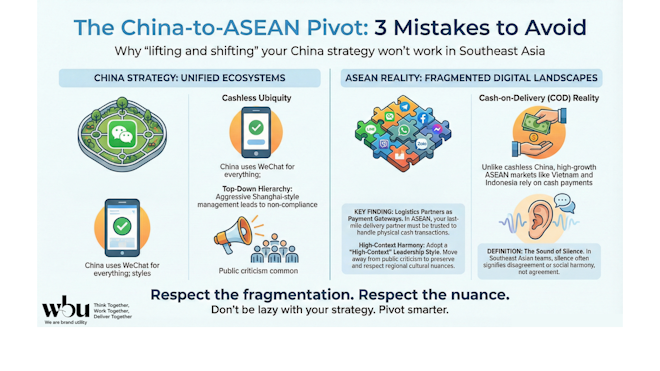
In China, you can run your entire business on WeChat. It handles your marketing, your customer service, and your payments. It is a walled garden that works perfectly.
Leaders often arrive in ASEAN looking for the "WeChat of Southeast Asia." It does not exist.
The Reality: The ASEAN digital landscape is fragmented.
- Singapore & Malaysia: Dominant on WhatsApp for communication, but rely on credit cards and GrabPay for transactions.
- Thailand: Entirely dependent on LINE for customer service (a completely different ecosystem to WhatsApp).
- Vietnam: Heavily reliant on Zalo and Facebook Messenger.
- Indonesia: A mix of WhatsApp, Tokopedia, and Shopee.
The Fix: You cannot build a single "super-app" strategy. You must build a multi-channel operational model that can handle LINE in Bangkok and WhatsApp in Jakarta simultaneously.
Mistake 2: The "Cashless" Misunderstanding
China is virtually cashless. Alipay and WeChat Pay are ubiquitous. Western leaders assume Southeast Asia is the same because the smartphone penetration is high.
This is a fatal error for e-commerce brands.
The Reality: While Singapore is cashless, large parts of Vietnam, Indonesia, and the Philippines still rely heavily on "Cash on Delivery" (COD).
- In Vietnam, a significant percentage of e-commerce orders are paid for in cash at the doorstep.
- If your checkout flow requires a credit card, you are instantly alienating mass-market consumers in these high-growth nations.
The Fix: Your logistics partner is just as important as your payment gateway. You need "last-mile" partners who are trusted to handle cash transactions.
Mistake 3: The Cultural "Hierarchy" Trap
In China, business culture often respects strict hierarchy and top-down decision-making. Negotiation styles can be direct and rapid.
Leaders often apply this same aggressive, top-down management style to teams in Thailand or the Philippines.
The Reality:
- Thailand: The concept of ‘consideration for others’ means employees will rarely openly disagree with a boss, even if the boss is making a mistake. A loud, direct manager will simply be met with silence and non-compliance.
- Philippines: There is a high value on ‘social harmony’. Public criticism creates bad morale, and further alienates team members who prefer a softer, more indirect approach.
The Fix: You need a "high-context" leadership style. You must learn to read the silence in a meeting room. If you treat your Bangkok team like your Shanghai team, you will lose them in three months.
The We are Brand Utility Perspective
The pivot from China to ASEAN is the right strategic move for 2026. The growth data supports it.
But do not be lazy with your strategy. Respect the fragmentation. Respect the nuance.
If you need help auditing your GTM strategy before you launch, an external Strategic Advisor can save you months of wasted effort.
Sources:
- Bain & Company - 'e-Conomy SEA 2024' - https://www.bain.com/insights/e-conomy-sea-2024/
- McKinsey & Company - 'The future of Asia: Asian flows and networks' - https://www.mckinsey.com/featured-insights/asia-pacific/the-future-of-asia-asian-flows-and-networks-are-defining-the-next-phase-of-globalization