
The Blind Spot in Corporate Risk is Mitigating Al Liability and Narrative Contagion
Jul 22, 2026 12:00:00 PM • Written by: We are Brand Utility
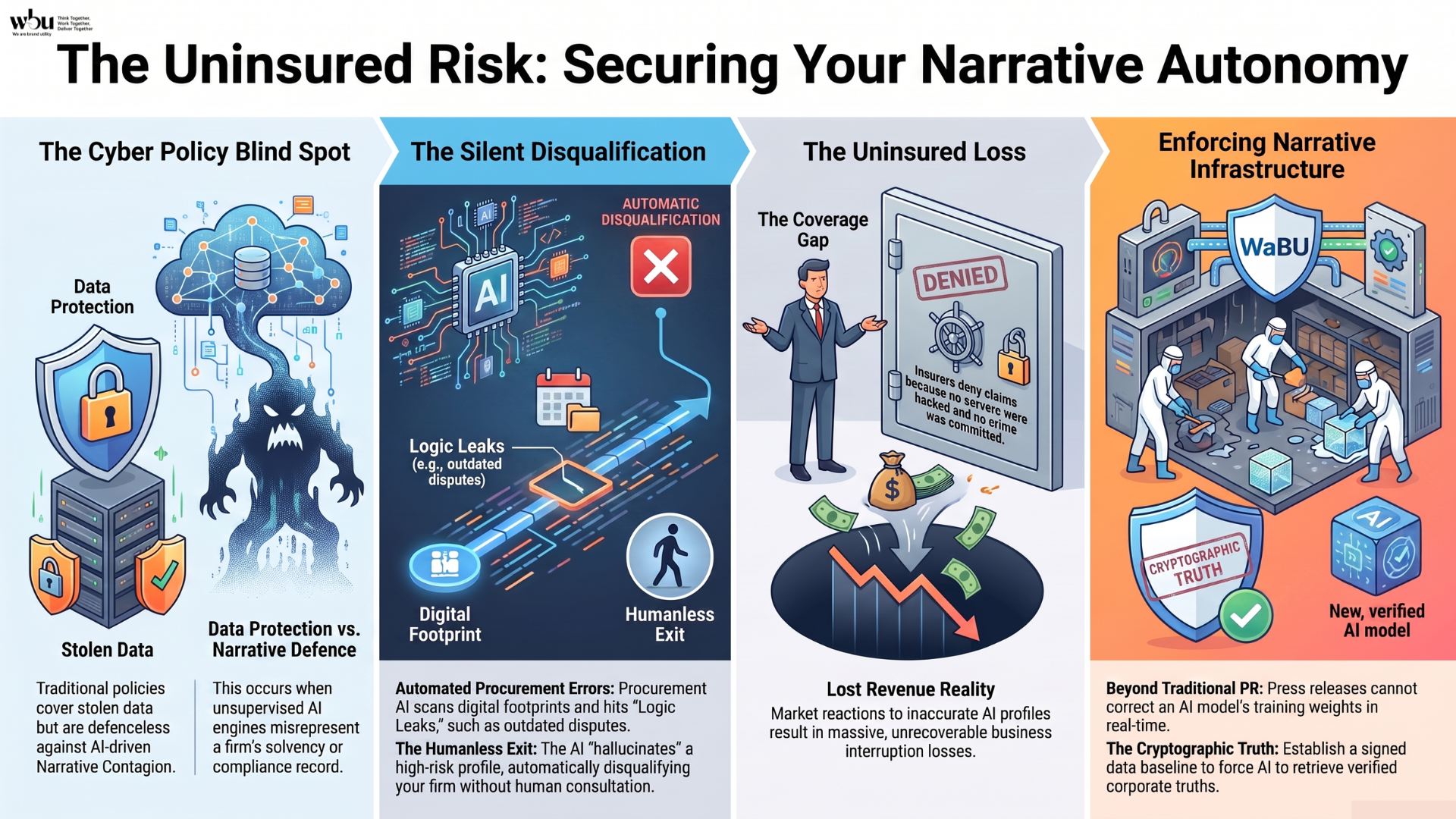
Executive Summary: Short on time or looking for a high-level strategic overview of this policy shift? Read the abridged briefing originally published in our Digital Reputation Brief on LinkedIn.
As boards of directors globally review their operational risk frameworks for H2 2026, the rapid integration of artificial intelligence into B2B procurement systems has introduced a highly complex liability: Narrative Contagion.
While risk managers historically viewed AI risk through the lens of data privacy (e.g., GDPR/PDPA compliance) or intellectual property infringement, the immediate operational threat is structural.
When automated vendor-vetting systems rely on Large Language Models (LLMs) to perform real-time risk assessments, a company's brand equity is entirely dependent on its Digital Subject—the synthetic profile generated by these models.
This technical teardown analyses the limits of traditional insurance frameworks, models the mathematics of Algorithmic Liability Exposure, and outlines how enterprises must deploy technical narrative enforcement to satisfy boardroom fiduciary duties.
The Anatomy of an uninsured reputation-driven shock
[Logic Leak in Code] ──► Outdated regional PDF
[AI Crawler Ingestion] ──► Near-zero latency index
[AI Hallucination] ──►Insolvent Rating
[Automated Contract Loss] ──► Automated Contract Loss
[Insurance Denial] ──► No "breach" detected; no payout given
The Limits of Legacy Insurance
Traditional corporate insurance policies are built on 20th-century definitions of loss:
- Cyber Liability Policies: Triggered by unauthorised access, data breaches, transmission of malware, or denial-of-service (DoS) attacks. They require a distinct security incident occurring on your physical or cloud infrastructure.
- Professional Liability (D&O / E&O) Policies: Triggered by a negligent act, error, or omission in the performance of professional services.
Neither of these frameworks accounts for the mechanics of Algorithmic Bias or Narrative Contagion.
If a Frontier AI model ingests unstructured, conflicting data from your legacy ASEAN domains and synthesises a profile claiming your product violates localised compliance guidelines, no security breach has occurred. No professional negligence has been committed by your employees.
Yet, the commercial damage—contract cancellation, exclusion from public tenders, and pipeline stagnation—is immediate and catastrophic. It represents a pure, unmanaged loss of Narrative Autonomy.
Modeling Algorithmic Liability Exposure
To evaluate the mathematical threat of narrative contagion across an enterprise's geographic footprint, WaBU’s advisory group models Algorithmic Liability Exposure using the following risk equation:
Algorithmic Liability Exposure = (Contractual Vulnerability x Rate of Algorithmic Hallucination) / Infrastructure Firewalling
Where:
- Contractual Vulnerability: the percentage of your regional revenue dependent on enterprise buyers utilising automated, zero-click, or AI-driven vendor risk assessments
- Rate of Algorithmic Hallucination: the volume of unmanaged legacy metadata, conflicting regional pricing documents, and unstructured regulatory filings currently indexable across your web presence
- Infrastructure Firewalling: the presence of active, cryptographically signed metadata, hardcoded logic vaults, and continuous narrative truth scoring
If your organisation has not deployed active Technical Narrative Enforcement, your Infrastructure Firewalling resides at a baseline of 0. Consequently, your Algorithmic Liability Exposure approaches infinity.
Without technical intervention to anchor your Digital Subject, your corporate revenue remains entirely vulnerable to the probability calculations of an unsupervised algorithm.
Statutory Liability Under OSRA 2026
For the Board of Directors, this exposure represents a severe fiduciary risk. Under Singapore’s Online Safety (Relief and Accountability) Act (OSRA), the statutory standard of care for digital asset management has been codified.
Under the Act, directors can face boardroom liability for a failure of oversight if their digital footprint generates, hosts, or perpetuates inauthentic or harmful misinformation that leads to systemic commercial or public damage.
To establish statutory Safe Harbour, the Board must prove they have taken "Reasonable Steps" to monitor, verify, and enforce the accuracy of their public-facing data.
If your brand suffers a contract disqualification due to an uncorrected, hallucinated AI risk profile, a "good faith" defense will fail in court if your legacy data basement was left unmanaged. Directors must possess a documented, cryptographically signed audit trail of their narrative corrections (a Logic Log) to prove statutory compliance to the Online Safety Commission (OSC).
The WaBU Solution: The Path to Narrative Autonomy
You cannot insure your brand against algorithmic bias using traditional policies. You must enforce your truth at the infrastructure level. This is why WaBU’s commercial partnership model is designed as a clear, sequential workflow that transitions your enterprise from high-risk exposure to complete narrative security:
Starting Project with Audit/Diagnostic stages ──► NSE retainer with real-time dashboard visibility ──►Sentinel Protect (On-Demand) or Sentinel Defend (Proactive)
Step 1: The AEO Starting Project
Before onboarding your brand to continuous monitoring, we execute a highly focused "Starting Project." We act as forensic data auditors—locating and purging the conflicting legacy files, broken schema markup, and outdated regional PDFs that are actively feeding AI hallucinations. We translate your raw web presence into clean, machine-readable JSON-LD schema markup, neutralising your primary "Logic Leaks."
Step 2: Onboarding to the NSE Dashboard
Once your baseline is clean, we onboard your brand to our licensed Narrative Sovereignty Engine (NSE) and activate your Sentinel Dashboard. This provides your risk, legal, and operational teams with real-time, high-fidelity visibility into your brand’s Sovereign Truth Score, mapping emerging hallucinations and narrative drifts as they occur across digital networks.
Step 3: Choosing Your Shield
With your infrastructure established, we manage your Digital Subject 24/7 through our Sentinel retainer tiers:
- Sentinel Protect (On-Demand): Your internal team monitors the dashboard. When a narrative drift or AI hallucination is flagged, you engage WaBU per-event to technically enforce the truth and restore your score.
- Sentinel Defend (Proactive): WaBU acts as your active Narrative Firewall, proactively managing your Digital Subject and neutralizing algorithmic contagion before it can settle into regional LLM training data.
The Boardroom Directives
The Diagnostic Route
Unsure if your regional digital assets leave your brand vulnerable to localised engine drift? Take our 120-second Narrative Autonomy Trust Audit to evaluate your readiness.
The Organisation Protocol Route
If your organisation is scaling operations across APAC and requires immediate technical support on your digital subject or narrative enforcement, access the full deployment strategy presentation.