
Singapore AI Regulatory Blueprint - What SEA Enterprises Need to Know
Oct 6, 2026, 10:00:00 AM • Written by: We are Brand Utility
For enterprises expanding across Southeast Asia, establishing a commercial presence in Singapore is rarely just about accessing the domestic market.
Singapore functions as the regional benchmark. Operational protocols, compliance frameworks, and corporate governance standards established here routinely set the pace for expansion into Malaysia, Indonesia, Thailand, and Vietnam.
Over the past eighteen months, that regional influence has extended decisively into artificial intelligence governance and digital market conduct.
When prospective corporate partners, institutional investors, or enterprise procurement leads evaluate a regional market entrant, they no longer rely solely on official regulatory filings or marketing pitch decks. Instead, procurement analysts and diligence teams query conversational AI search engines:
Does FinTech Firm A hold direct licensing in Singapore, and does that licence extend cross-border services into Malaysia and Indonesia?
What are the verified dispute resolution mechanisms and statutory liability limits for InsurTech Provider B across SEA?
Has Supplier C faced compliance inquiries or formal operational sanctions from regional market regulators?
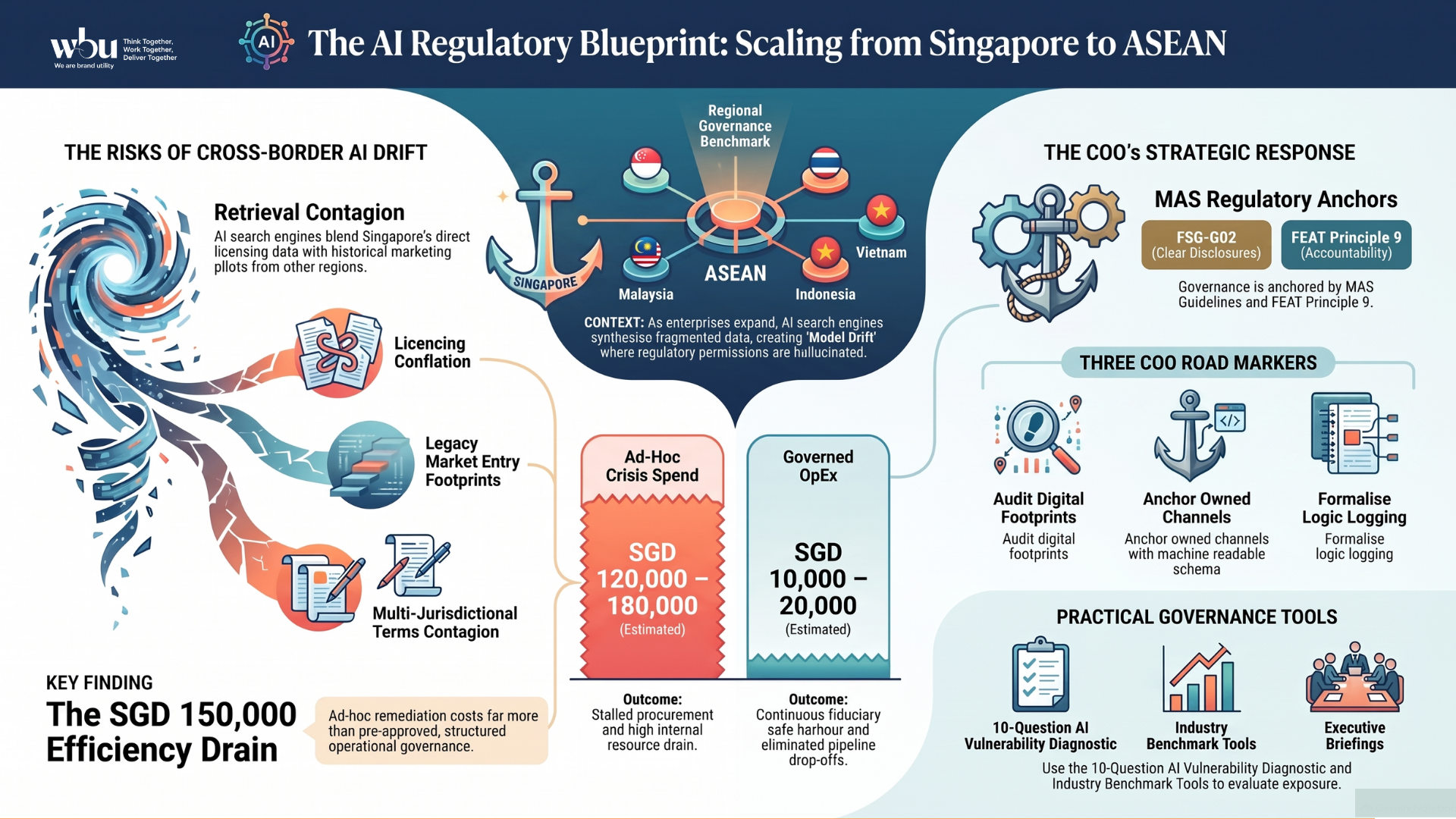
When autonomous search engines answer these queries, they scrape and synthesise fragmented data across multiple Southeast Asian jurisdictions—blending legacy cross-border partner announcements, expired trial terms, and conflicting regulatory disclosures.
In cross-border digital financial services and enterprise operations, this produces acute Cross-Border AI Model Drift.
Example:
CROSS-BORDER RETRIEVAL CONTAGION happens when:
-
Content/input from a Singapore Licensing Portal (Direct MAS Regulated Entity) is ingested alongside content from an Indonesian Partner Blog (e.g. a Historical Marketing Pilot) by a Public AI Search Engine.
-
It generated a hallucinated regional scope e.g. Firm A is licensed to conduct direct lending across ASEAN with zero local entity requirements.
-
This is reviewed by an Institutional Partner who flags statutory discrepancy during a due diligence exercise
Understanding the Regional Ripple Effect
Regional regulators across Southeast Asia closely monitor policy developments initiated in Singapore.
The Monetary Authority of Singapore (MAS) established clear regulatory markers through its Guidelines on Standards of Conduct for Marketing and Distribution Activities (FSG-G02). Under these guidelines, regulated institutions are explicitly expected to:
"Ensure that all marketing materials are clear, fair, and not misleading, and contain disclosures that are necessary to enable customers to make informed decisions."
Furthermore, under the MAS Principles to Promote Fairness, Ethics, Accountability and Transparency (FEAT) in the Use of AI and Data Analytics, the regulator establishes the core principle of Accountability:
AIDA-driven decisions are held to account. Regulated entities should ensure that internal governance frameworks, including accountability structures, are in place to address the risks of AIDA-driven decision-making.
While regulators in neighbouring jurisdictions—such as Bank Indonesia (BI), the Otoritas Jasa Keuangan (OJK), and the Securities Commission Malaysia—maintain distinct domestic statutory mandates, regional regulatory roundtables frequently adopt MAS frameworks as a functional reference point.
When a SEA entrant allows unanchored, contradictory corporate representations to circulate freely across AI search engines, the issue is not merely technical. It creates statutory ambiguity during banking partnership reviews, institutional capital raises, and commercial due diligence.
The Three Operational Pitfalls of Regional Expansion
Across regional diagnostics, three structural disclosure issues repeatedly compromise expanding mid-market firms:
- Cross-Border Licensing Conflation: Autonomous search tools regularly fail to separate single-market regulatory permissions from regional operations. An entity holding an MAS Major Payment Institution (MPI) licence in Singapore may be synthesised as being "fully authorised for direct onshore deposit-taking in Indonesia," exposing the firm to local regulatory scrutiny.
- Legacy Market Entry Footprints: Rapidly scaling companies often run pilot programmes or localized promotions in specific markets. When these programmes conclude, unindexed landing pages and third-party press releases remain live on regional portals. AI search scrapers treat these expired frameworks as active corporate policies.
- Multi-Jurisdictional Terms Contagion: Cancellation policies, dispute resolution terms (such as FIDReC in Singapore vs. local arbitration bodies), and statutory liability caps get blended into hybrid responses that fail to reflect the legal realities of any single market.
Qualitative Road Markers for Expanding COOs
Let’s be clear. Given the evolving multi-jurisdictional landscape, no operational model can guarantee that external, probabilistic large language models will never misinterpret a complex regulatory prospectus.
Anyone offering absolute technical guarantees over third-party search engines fundamentally misrepresents how probabilistic software operates.
Despite this limitation, operational leaders expanding across Southeast Asia can establish qualitative road markers that significantly reduce model uncertainty:
1. Audit Multi-Jurisdictional Digital Footprints
Instruct your regional operations and marketing teams to catalogue every public disclosure, partner announcement, and legal terms page across all active ASEAN domains. Identify and decommission obsolete regional microsites and unindexed pilot documentation.
2. Deploy Infrastructure and Owned Channel Anchoring
Translate market-specific licensing boundaries, dispute venues, and commercial terms into structured, machine-readable formats hosted directly on your primary digital infrastructure. By anchoring authoritative corporate facts on owned channels, you provide search crawlers with verified, unambiguous source data for each specific jurisdiction.
3. Formalise Logic Logging for Multi-Market Due Diligence
Implement automated, persistent monitoring that systematically tests how AI platforms present your regulatory status, fees, and operational terms across different regional query contexts.
Managing regional AI representation is an operational hygiene imperative. Leaders who treat digital disclosures as governed infrastructure protect their cross-border credibility and build defensible foundations across Southeast Asia.
Take control of your brand's digital representation with two practical starting points:
- Internal Governance Audit: Complete the 10-Question AI Vulnerability Diagnostic to evaluate your cross-border readiness and receive a board-ready score.
- Sector Loss Benchmarking: Use the Interactive Industry Benchmark Tool to model your organisation's exact exposure across 50 regional enterprise baselines.
For executive teams seeking a direct, peer-level discussion, we host private Executive Briefings (capped at 8 leaders per session) in Singapore under Chatham House Rule.
Connect with us for an invitation to our next Executive Briefing or submit your organisation for an asynchronous Digital Risk Snapshot.
The Boardroom Directives
The Diagnostic Route
Unsure if your regional digital assets leave your brand vulnerable to AI Hallucinations and drift? Take our 3-minute AI Vulnerability Audit to evaluate your risk and readiness.
The Organisation Protocol Route
If your organisation is entering or scaling operations across APAC and want to understand how hallucinations are impacting your GTM and revenue pipeline, use our 5 sector, 50-company benchmark calculator to aid your decision-making.