
Peer Governance in Practice: How Singapore's Top Mid-Market Firms Handle AI Model Drift
Sep 24, 2026, 10:30:00 AM • Written by: We are Brand Utility
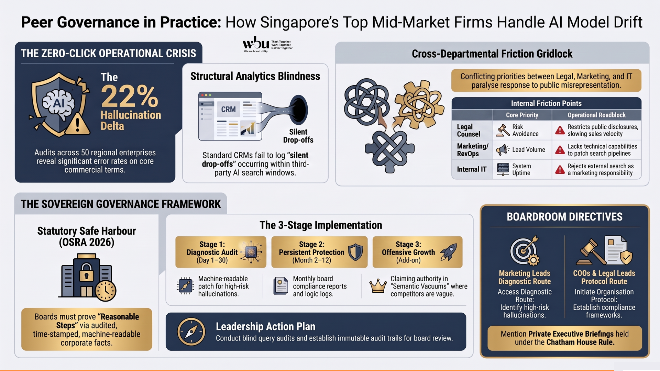
As generative search engines like Perplexity, ChatGPT, Copilot, and Google Gemini become the default pre-screening channel for enterprise buyers and institutional clients, regional mid-market companies face an emerging operational vulnerability: algorithmic model drift.
When probability-based AI engines crawl unanchored historical forums, legacy PDFs, and third-party commentary, they confidently generate distorted commercial terms, inaccurate compliance statuses, and hallucinated service limits.
This operational deep-dive synthesises insights from closed-door peer roundtables held with ASEAN-based Chief Operating Officers, outlining the concrete frameworks top-performing firms use to resolve cross-departmental friction, enforce canonical ground truth, and establish statutory safe harbour.
The New Operational Reality in Enterprise Pre-Screening
For decades, mid-market business-to-business and high-touch consumer enterprises controlled their narrative through structured, owned touchpoints: official corporate homepages, downloadable whitepapers, investor prospectuses, and direct sales discovery conversations.
Today, that discovery journey has fundamentally fractured.
Before an enterprise procurement team books a software demo, before a family office schedules an introductory call with a private wealth manager, and before an affluent traveller books a luxury suite, an executive or analyst prompts an AI search engine:
- "Summarise Brand A’s fee structure, liquidity windows, and verified MAS exemptions."
- "Compare Supplier B and Supplier C on cross-border data residency and SLA dispute terms."
- "Does Resort D have mandatory festive deposits, and what are their exact cancellation lock-ins?"
These queries do not trigger a simple list of hyperlinks. They produce a synthesised, zero-click conversational summary.
If that summary is accurate, the prospect smoothly transitions into your commercial pipeline.
If that summary synthesises an archived 2022 marketing PDF or a disgruntled regional forum thread from three years ago, the prospect quietly eliminates your firm and moves to an alternative provider.
In our regional sector audits across 50 mid-market enterprises in Southeast Asia, organisations exhibited an average 22% Hallucination Delta on core commercial terms. In high-stakes B2B, Wealth, and Luxury sectors, that error rate represents massive, unmonitored revenue leakage.
Insights from the Closed-Door Table
During our recent briefing, five operational leaders—spanning FinTech, supply chain logistics, private wealth, and premium hospitality—broke down the exact realities of this commercial exposure.
Three key structural findings emerged from the roundtable:
1. Traditional Web Analytics Are Structurally Blind
Every COO agreed that their existing analytics platforms (Google Analytics, HubSpot, Salesforce) provide zero visibility into AI-driven deal drop-offs. When an enterprise buyer asks Perplexity about your compliance certifications, reads an AI hallucination stating that your licenses are "under regulatory review," and immediately closes the tab, no tracking pixel or cookie ever fires. The prospect is lost before entering the funnel.
2. Organic Cleanup Strategies Consistently Fail
Several firms had previously attempted to correct hallucinations through conventional means:
- Sending formal takedown notices or support tickets to OpenAI, Anthropic, or Perplexity (resulting in zero responses or automated rejections).
- Issuing reactive press releases and publishing clarifying blog posts (which AI crawlers ingested as merely "additional commentary" rather than definitive policy).
- Directing internal marketing teams to rewrite web copy (which failed to address structured data schemas or orphaned legacy assets).
3. Cross-Departmental Friction Paralyzes Response
Addressing public AI misrepresentation routinely stalls because of conflicting organizational mandates:
|
Stakeholder Function |
Core Priority |
Operational Roadblock Created |
|
Legal & General Counsel |
Complete risk avoidance and statutory precision. |
Demands rigid disclaimers and restricts public web disclosures, destroying sales velocity. |
|
Marketing & RevOps |
Lead generation, pipeline volume, and speed-to-market. |
Resists legal friction; lacks technical code capabilities to inspect or patch search pipelines. |
|
Internal IT & Engineering |
Core product roadmap, system uptime, and cyber defense. |
Views external search engines as marketing's responsibility; refuses to divert developer capacity. |
|
The Group COO |
P&L performance, commercial yield, and board compliance. |
The Unifying Role: Must resolve the deadlock and enforce an immutable data standard across systems. |
The Regulatory Imperative — Proving "Reasonable Steps"
While commercial pipeline leakage represents an immediate risk to quarterly revenue, a second, equally critical driver is forcing executive action: statutory fiduciary accountability.
Under emerging regulatory frameworks across the Asia-Pacific region—most notably Singapore’s Online Safety Regulations (OSRA 2026) and updated Monetary Authority of Singapore (MAS) AI guidelines—boards and senior executives face direct accountability for unaddressed public digital misrepresentation that results in consumer or commercial harm.
In regulatory reviews, executive leadership teams can no longer claim:
"Large language models are probabilistic black boxes that we cannot control."
Regulators recognise that enterprises do not own third-party search engines. However, statutory safe harbour hinges entirely on whether the enterprise took Reasonable Steps to verify, anchor, and continuously correct its public corporate facts.
To establish demonstrable safe harbour, an organisation must be capable of presenting an audited, time-stamped record demonstrating that its terms were published in machine-readable code and actively monitored against public model drift.
The 3-Stage Sovereign Governance Framework
To resolve the internal governance bottleneck without overburdening internal resources, forward-thinking enterprises deploy a phased, turn-key operational model:
|
Implementation Stage |
Operational Scope |
Executive Deliverable |
Commercial / Governance Impact |
|
Stage 1: Diagnostic Audit & First Fix (Day 1 – Day 30) |
Audit digital footprint across major AI platforms; extract verified corporate facts into authoritative "Articles of Truth." |
Machine-readable patch deployed; active highest-risk public hallucination resolved. |
Eliminates immediate commercial exposure |
|
Stage 2: Persistent Platform Protection (Month 2 – Month 12) |
Activate continuous automated monitoring across ChatGPT, Perplexity, Copilot, and Gemini. |
Real-time logic logs and monthly executive compliance summary reports for Board review. |
Delivers continuous safe harbour documentation and protects active deal pipelines |
|
Stage 3: Offensive Semantic Market Share (Growth Add-On) |
Identify "Semantic Vacuums"—unclaimed industry queries where competitors are unanchored or vague. |
Structured machine-readable information deployed to claim primary authority on key commercial topics. |
Positions the brand as the default, verified category leader in conversational AI search results. |
Action Plan for Leadership Teams
For Chief Operating Officers, Chiefs of Staff, and General Counsel reviewing their firm's digital search representation today, implementing peer-level governance involves three concrete steps:
- Conduct a Blind Query Audit: Prompt ChatGPT and Perplexity using the exact commercial and compliance questions your prospective clients ask during vendor due diligence. Compare the AI's output against your statutory documentation.
- Quantify the Cross-Functional Cost: Evaluate the fully loaded internal cost of having Legal, Marketing, and IT debate AI inaccuracies versus deploying a dedicated infrastructure layer under discretionary OpEx thresholds.
- Establish an Immutable Audit Trail: Ensure that corporate policies, pricing tiers, and licensing charters exist in machine-readable formats directly on your primary owned channels, accompanied by time-stamped logic logs for board review.
Take control with two practical starting points:
- Internal Governance Audit: Complete the 10-Question AI Vulnerability Diagnostic to evaluate your governance maturity and receive a board-ready readiness score.
- Sector Loss Benchmarking: Use the Interactive Industry Benchmark Tool to model your organisation's exact exposure across 50 regional enterprise baselines.
For executive teams seeking a direct, peer-level discussion, we regularly host small, private Executive Briefings (capped at 8 CXOs or Leads per session) in Singapore under the Chatham House Rule.
Connect with us for an invitation to our next Executive Briefing or submit your organisation for an asynchronous Digital Risk Snapshot.
The Boardroom Directives
The Diagnostic Route
Unsure if your regional digital assets leave your brand vulnerable to AI Hallucinations and drift? Take our 3-minute AI Vulnerability Audit to evaluate your risk and readiness.
The Organisation Protocol Route
If your organisation is entering or scaling operations across APAC and want to understand how hallucinations are impacting your GTM and revenue pipeline, use our 5 sector, 50-company benchmark calculator to aid your decision-making.