
Move AI Risk from Unbudgeted Threat to OpEx Certainty in 2027: Budget Edition
Oct 8, 2026, 10:00:00 AM • Written by: We are Brand Utility
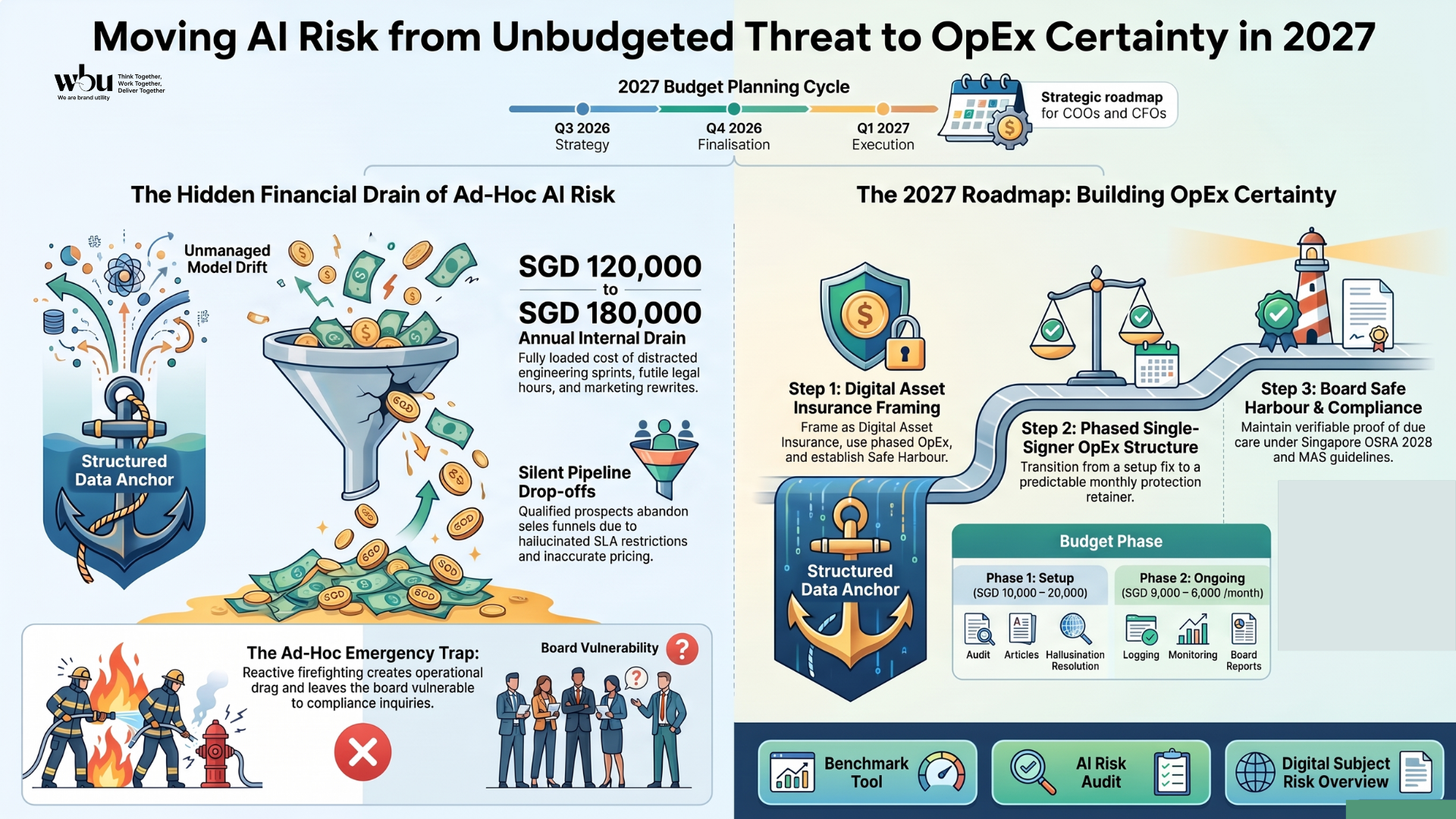
Across the enterprise landscape, October represents a critical operational window. Chief Operating Officers, Chiefs of Staff, and Chief Financial Officers are finalising operating expense (OpEx) allocations and capital priorities for the upcoming fiscal year.
During these planning cycles, an operational tension routinely surfaces: how to handle new, unbudgeted risks that straddle multiple corporate functions.
Over the past year, public generative AI search engines—such as ChatGPT, Perplexity, Microsoft Copilot, and Google Gemini—have become default research layers for corporate buyers, institutional partners, and consumers. As these tools ingest outdated marketing brochures, conflicting forum commentary, and obsolete product summaries, they produce distorted commercial terms, inaccurate pricing tiers, and hallucinated compliance records.
When this occurs, the commercial damage is tangible:
- Qualified prospects quietly abandon sales funnels after reading hallucinated SLA restrictions.
- Institutional due diligence stalls due to conflicting licensing disclosures.
- Executive teams scramble to coordinate emergency cross-departmental cleanup meetings.
Yet, in most mid-market organisations, there is no dedicated line item for "AI Search Representation Accuracy" or "Algorithmic Data Integrity."
Leaving narrative protection as an ad-hoc emergency creates operational drag, inflates internal costs, and leaves the board vulnerable to compliance inquiries.
The strategic mandate for COOs this budgeting cycle is clear: transition digital narrative protection from an unpredictable crisis into a predictable, approved operational line item.
A tale of 2 situations: AD-HOC CRISIS SPEND vs. GOVERNED OpEx ALLOCATION
THE AD-HOC EMERGENCY TRAP (UNBUDGETED)
AI Drift Identified
──►
Emergency Executive team Alignment
──►
Legal Drafts Ineffective Notices (SGD 10,000+ in billable legal hours)
Marketing Rewrites Web Copy (Focus diverted from pipeline)
──►
Stalled in Procurement / CapEx Review (SGD 150,000+ fully loaded internal drain)
VS.
THE PRE-APPROVED OpEx ALLOCATION (STRUCTURED)
Fixed Line Item (Single-Signer OpEx)
──►
Infrastructure Anchoring (Structured Schema on Owned Channels
──►
Persistent Logic Logs (Automated Board Proof)
──►
Silent Pipeline Drop-offs Eliminated and Continuous Fiduciary Safe Harbour Maintained
The True Financial Drain of "Free" Internal Remediation
When a Chief Operating Officer proposes allocating budget to manage AI search drift, the natural pushback from the CFO or Finance Committee is predictable:
"Why do we need external software or advisory spend for this? Can't our Marketing team or IT department handle inaccurate search results internally?"
To evaluate this objection objectively, operational leaders must calculate the fully loaded internal cost of ad-hoc remediation versus structured operational stewardship:
1. The Distraction of Core Engineering Teams
Directing internal software engineers or IT infrastructure specialists to investigate external AI scraping pipelines, deploy ad-hoc schema, and monitor third-party search crawlers diverts sprint capacity away from primary product road-maps and revenue-generating features.
2. Legal and Compliance Hours
When public AI engines mis-state warranty terms or regulatory statuses, General Counsel typically reacts by drafting formal correction notices or complex website disclaimers. External AI platforms routinely ignore manual takedown requests, meaning dozens of billable legal hours are expended with zero measurable impact on search engine outputs.
3. Marketing and RevOps Inefficiency
Marketing teams attempt to counter AI hallucinations by publishing reactive blog posts, press releases, or social media updates. Because large language models prioritise structured data hierarchy over unstructured marketing copy, these efforts add more noise to the web without repairing the underlying retrieval logic.
When fully loaded executive salaries, legal fees, and engineering opportunity costs are aggregated, organisations routinely absorb between SGD 120,000 to SGD 180,000 in reactive internal friction—without obtaining an immutable audit trail that demonstrates due diligence to the board.
The 3-Step Framing for the 2027 COO Board Memo
To secure executive alignment and position narrative sovereignty as a necessary 2027 line item, COOs should anchor their proposal around three operational justifications:
1. Frame It as Digital Asset Insurance & Yield Protection
Do not position the spend as experimental "AI exploration" or discretionary marketing software. Frame it as core revenue protection.
Demonstrate that if unanchored AI summaries cause just one or two high-value enterprise accounts or institutional clients to quietly select a competitor during preliminary research, the lost annual recurring revenue dwarfs the cost of operational protection. A modest fixed OpEx commitment protects top-of-funnel conversion efficiency and customer acquisition costs (CAC).
2. Structure Around Single-Signer OpEx Thresholds
Navigating formal procurement committees for large, multi-year IT capital expenditures (CapEx) can take six to nine months.
Forward-thinking COOs structure narrative protection as a phased operational protocol:
- Phase 1 (Setup & Initial Fix): Deployed under standard single-signer OpEx discretionary thresholds (typically between SGD 10,000 to 20,000), covering the baseline audit, creation of Articles of Truth, and resolution of the primary active hallucination.
- Phase 2 (Ongoing Platform Protection): A predictable monthly operating retainer (SGD 5,000 - 8,000/month) that covers continuous automated drift monitoring, logic logging, and executive compliance reports.
3. Establish Board Safe Harbour Documentation
Under emerging regulatory frameworks—such as Singapore’s Online Safety Regulations (OSRA 2026) and updated MAS guidelines—boards and senior executives face scrutiny regarding whether the institution exercised reasonable due care in preventing public misrepresentation.
Highlight that an ad-hoc internal response produces zero evidentiary documentation. By contrast, deploying infrastructure and owned channel anchoring alongside logic logs provides an audit-ready ledger that proves the organisation took proactive, demonstrable steps to protect consumer and enterprise disclosures.
Moving into 2027 with Operational Clarity
Artificial intelligence search engines are not passing novelties; they represent the primary information discovery layer for the coming years. Leaving how your corporate facts, pricing, and compliance standing are represented to chance is an unforced operational vulnerability.
By securing pre-approved operational certainty in the Q1 2027 budget, COOs and leaders protect active sales cycles, eliminate wasteful cross-functional firefighting, and provide their boards with verifiable governance assurance.
Connect with us for an invitation to our next Executive Briefing or submit your organisation for an asynchronous Digital Risk Snapshot.
The Boardroom Directives
The Diagnostic Route
Unsure if your regional digital assets leave your brand vulnerable to AI Hallucinations and drift? Take our 3-minute AI Vulnerability Audit to evaluate your risk and readiness.
The Organisation Protocol Route
If your organisation is entering or scaling operations across APAC and want to understand how hallucinations are impacting your GTM and revenue pipeline, use our 5 sector, 50-company benchmark calculator to aid your decision-making.