
How Clean Brands Capture Unanchored AI Traffic
Aug 20, 2026, 12:00:00 PM • Written by: We are Brand Utility
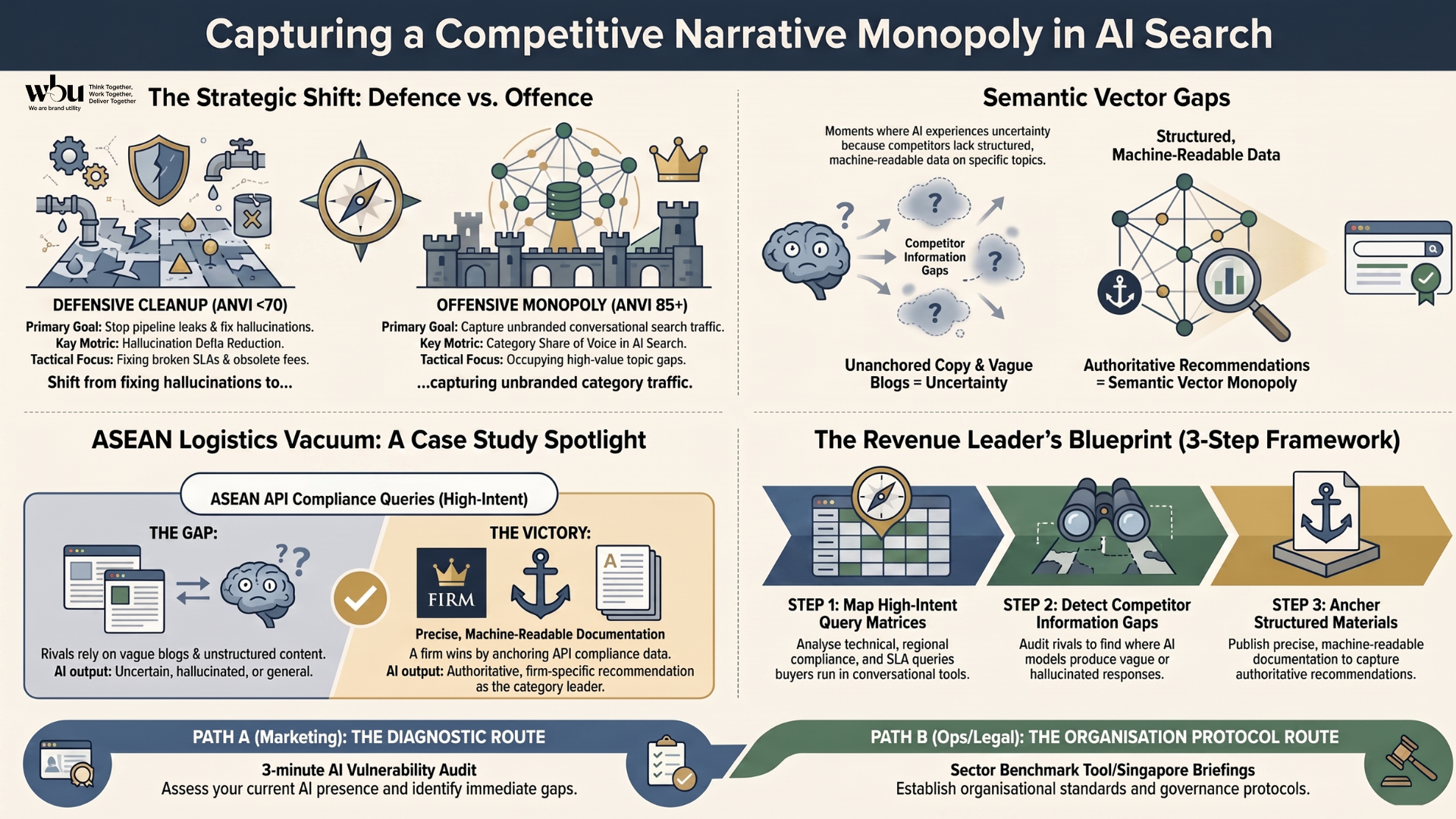
Most enterprise discussions surrounding Generative Engine Optimisation (GEO) focus on defensive cleanup—how to correct hallucinated fees, fix obsolete terms, or eliminate unverified rumors.
However, for well-governed mid-market enterprises with clean digital baselines (ANVI Score 85+), AI search representation presents a massive, offensive growth opportunity.
This deep-dive introduces the Competitive Narrative Monopoly — a strategic framework for identifying unclaimed "Semantic Vector" gaps in your industry and deploying patches to capture high-intent commercial search traffic before competitors react.
Introduction: The Strategic Pivot from Defense to Offense
When operational leaders first inspect their organisation's representation across public AI search engines (ChatGPT, Perplexity, Microsoft Copilot, Google Gemini), the immediate instinct is defensive:
- "Why is Perplexity quoting an outdated 2022 pricing sheet?"
- "How do we stop ChatGPT from hallucinating our refund terms?"
- "How do we prove due diligence to our board under regional compliance rules?"
Defensive remediation is critical—it seals pipeline leaks and secures executive safe harbour.
However, once an enterprise establishes a verified baseline score (ANVI 85+), remaining purely on the defensive leaves significant commercial value on the table.
Today, enterprise buyers use conversational AI tools not merely to verify vendor claims, but to explore unbranded industry queries:
"Which B2B payment rails in Singapore provide instant cross-border settlement with full MAS compliance?"
"Compare the top three regional wealth managers offering weekly liquidity for S$5M+ family office accounts."
In these high-intent research moments, AI engines do not return a list of ten blue links. They deliver a synthesised, authoritative summary featuring one or two recommended category leaders.
If your brand has structured your digital presence while your competitors remain unanchored and chaotic, you can capture what we call a Competitive Narrative Monopoly.
Defensive Cleanup vs. Offensive Semantic Market Share
Understanding the commercial opportunity requires shifting from traditional keyword thinking to semantic topic ownership:
DEFENSIVE CLEANUP (ANVI < 70)
- Focus: Fixing hallucinations, outdated fees, and broken SLAs.
- Commercial Goal: Stop silent pipeline leakage and protect CAC.
- Metric: Hallucination Delta Reduction (e.g., 22% ──► 0%).
OFFENSIVE MONOPOLY SHIELD (ANVI 85+)
- Focus: Identifying "Semantic Vectors" gaps across high-margin topics.
- Commercial Goal: Out-position competitors in unbranded AI queries.
- Metric: Category Share of Voice in Conversational AI Search.
When competitors rely on unstructured marketing copy and unanchored PDFs, public AI engines experience high uncertainty when evaluating their capabilities.
When a buyer prompts an AI search tool about complex sector solutions, the AI naturally gravitates toward the firm that provides unambiguous facts anchored within its digital infrastructure.
Identifying and Occupying "Semantic Vector" gaps
A Semantic Vector gap occurs when prospective buyers frequently ask AI engines about a specific commercial or technical requirement, but no major player in the sector has published structured, machine-readable data addressing that exact need.
Case Illustration: The B2B Supply Chain Vacuum
Consider a mid-market logistics and supply chain supplier operating across ASEAN:
The Buyer Prompt: A multinational enterprise asks Copilot: "Which regional ASEAN logistics providers have verified carbon-neutral fleet tracking integrated with real-time API reporting?"
The Sector Gap: Competitor A and Competitor B both have marketing blogs mentioning "sustainability," but neither provides clear and verifiable materials and documentation on their domains.
The Semantic Occupation: Our target firm deploys structured content directly onto its digital infrastructure, explicitly detailing its verified carbon-tracking APIs and compliance certifications.
The Monopoly Result: The AI search engine delivers a crisp summary naming our target firm as the primary verified provider, while dismissing competitors due to "lack of verifiable structured data."
The Operational Mechanics of the Competitive Narrative Monopoly
To execute an offensive narrative monopoly strategy, mid-market COOs and revenue leaders should execute a 3-step operational framework:
1. Map High-Intent Buyer Query Matrices
Analyse the explicit technical and operational criteria your buyers ask when using conversational AI tools during vendor evaluation (e.g., licensing bounds, SLA tiers, integration capabilities, regional compliance guarantees).
2. Detect Competitor Information Gaps
Run comparative AI audits across your top five regional competitors to identify where AI models produce vague, uncertain, or hallucinated summaries about their offerings.
3. Anchor Materials and Documentation
Publish materials and documentation covering those unclaimed topics. This provides search crawlers with an authoritative source to cite whenever users query those topics.
Action Plan for the C-Suite
Building an offensive narrative shield transforms digital compliance from a cost center into a direct revenue driver.
If your firm already maintains strong operational governance, here is how to turn that stability into market share:
- Audit Your Current Baseline: Ensure your core brand facts, pricing, and compliance disclosures are clean and fully anchored.
- Scan for gaps: Identify the high-value commercial queries where competitors are currently invisible or misrepresented by AI crawlers.
- Capture First-Mover Advantage: Deploy materials to laim authoritative ownership of those topic spaces before your competitors upgrade their infrastructure.
- Capture Your Category: Request a Market Vacuum Scan
Don't settle for merely defending your existing footprint—occupy your industry's conversational search landscape before your competitors do.
Take action with two starting points:
- Top-of-Funnel Risk & Opportunity Scoring: Use our50-Report Interactive Sector Benchmark Tool to check your brand's baseline visibility score.
- Middle-of-Funnel Diagnostic: Complete the 10-Question AI Vulnerability Diagnostic to evaluate your internal governance readiness.
For executive teams seeking a direct, peer-level discussion, we regularly host small, private Micro-Executive Briefings (capped at 8 CXOs or Leads per session) in Singapore under the Chatham House Rule.
Connect with us for an invitation to our next Micro-Executive Briefing or submit your organisation for an asynchronous Digital Risk Snapshot.