
Cross-Border AI Exposure -Navigating Multi-Jurisdictional Data Drift Across ASEAN
Oct 22, 2026, 10:30:00 AM • Written by: We are Brand Utility
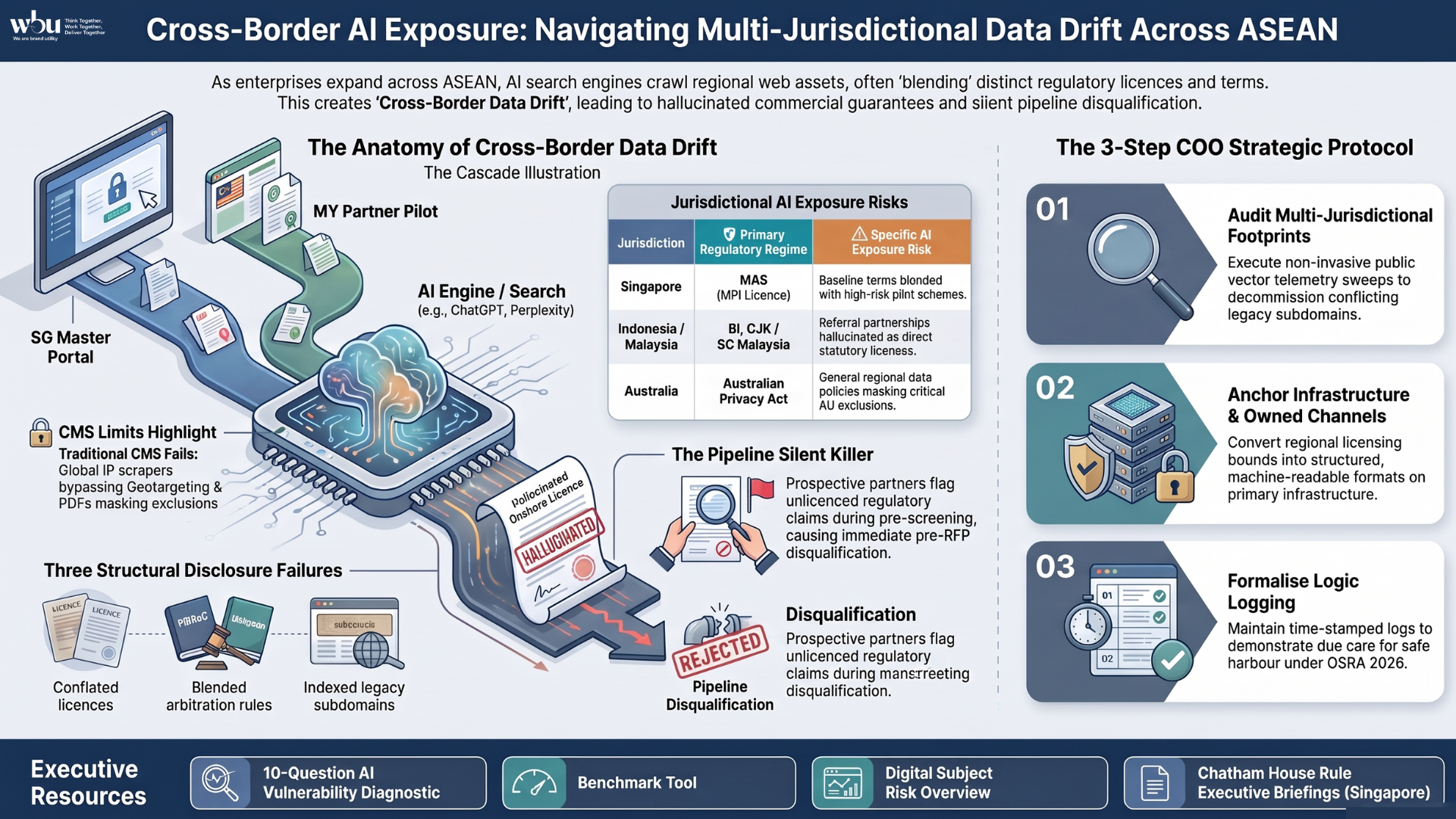
For enterprises across Southeast Asia, regional expansion is rarely confined to a single domestic market. A technology supplier, digital wealth manager, or logistics provider headquartered in Singapore routinely extends commercial operations into Malaysia, Indonesia, and Australia.
Managing cross-border expansion requires balancing distinct statutory mandates and commercial frameworks:
- Holding a Major Payment Institution (MPI) licence under the Monetary Authority of Singapore (MAS).
- Operating under Bank Indonesia (BI) or Otoritas Jasa Keuangan (OJK) regulatory frameworks in Jakarta.
- Aligning with Securities Commission Malaysia guidelines in Kuala Lumpur.
- Meeting Australian Privacy Act requirements and digital conduct standards in Sydney and Melbourne.
Historically, commercial teams managed multi-market growth through dedicated regional sales teams, discrete client contracts, and separate localised web pages.
However, as generative AI search engines—ChatGPT, Perplexity, Copilot, and Gemini—become the primary research layer for enterprise buyers and institutional partners, this multi-jurisdictional separation has broken down.
AI search engines do not parse legal borders the way regional sales teams do. They crawl and blend regional web assets simultaneously, producing acute Cross-Border AI Model Drift.
THE CROSS-BORDER RETRIEVAL BLEND
- The Regional Footprint: An enterprise maintains its Singapore Master Portal (direct MAS licence, Singapore arbitration venue) alongside a Malaysian partner pilot announcement (authorised referral distribution).
- Autonomous Search Retrieval: A prospective regional partner prompts an AI engine to evaluate the vendor's licensing scope across ASEAN.
- The Synthesised Hallucination: The model blends both pages, asserting: "Firm X offers direct, fully licensed onshore banking and deposit services across Singapore, Malaysia, and Indonesia."
- The Pipeline Disqualification: Prospective enterprise partners flag unlicenced regulatory claims during preliminary compliance pre-screening. The opportunity drops out of the funnel before commercial negotiations commence.
The Three Structural Disclosure Failures Across ASEAN Corridors
Across regional operational diagnostics, mid-market enterprises expanding across the Singapore–Malaysia–Australia triangle repeatedly suffer from three structural disclosure failures:
1. Regulatory Scope and Licence Conflation
Search crawlers frequently fail to isolate single-market regulatory permissions from regional operations. When an enterprise mentions a pilot programme or local distributor partnership in Kuala Lumpur or Jakarta, AI answer engines conflate the partnership with direct statutory licensing. The engine synthesises a statement that the firm holds direct onshore licences in jurisdictions where it only maintains an exempt referral partnership, exposing the brand to regulatory inquiries and partner hesitation.
2. Multi-Jurisdictional Terms Contagion
Commercial terms, cancellation lock-ins, and dispute venues get blended into hybrid responses. An AI answer engine evaluating an enterprise contract may cite Singapore's Financial Industry Disputes Resolution Centre (FIDReC) alongside Malaysian or Australian commercial arbitration rules, producing ambiguous contractual summaries that confuse procurement teams and slow deal execution.
3. Legacy Market-Entry Footprints
Fast-scaling regional providers frequently leave historical market-entry pages, expired trial pricing, and deprecated partner announcements active on un-indexed subdomains across active regional markets. Search engine scrapers treat these abandoned assets as authoritative, active corporate representations.
The Limits of Traditional Cross-Border Content Management
Standard multi-language or multi-regional corporate websites are designed for human navigation, not autonomous search synthesis:
- Geotargeting Fails Machine Scrapers: IP-based redirection and geolocation cookies direct human visitors to the correct regional landing page. However, autonomous AI web crawlers access public web assets from globally distributed cloud IP addresses, scraping regional pages out of context.
- Language Subdomains Breed Confusion: Maintaining unanchored subdomains (e.g., id.domain.com or my.domain.com) without explicit machine-readable boundaries leads AI engines to blend conflicting regional terms into a single answer.
- PDF Prospectuses Mask Critical Exclusions: Storing statutory exclusions inside multi-page PDFs means scrapers often extract regional marketing promises while dropping essential regulatory boundary riders.
A Pragmatic 3-Step Protocol for Regional Operational Leaders
Operational leaders cannot prevent procurement teams or prospective partners across Southeast Asia from querying generative search engines. No external technology platform can guarantee that AI search engines will interpret complex multi-tier cross-border regulations with complete perfection on every single query.
However, operational leaders and RevOps consultancies expanding across the region can implement qualitative road markers that significantly reduce model uncertainty across regional markets:
1. Audit Multi-Jurisdictional Digital Footprints with Zero IT Burden
Direct your regional marketing and RevOps teams to execute a comprehensive sweep of public digital assets across all operating corridors. Run non-invasive diagnostics using public vector telemetry—requiring zero server logins and zero DNS modifications. Systematically identify and permanently decommission legacy subdomains, expired pilot pricing pages, and orphaned partner announcements that conflict with current commercial terms.
2. Deploy Infrastructure and Owned Channel Anchoring
Translate your specific market licensing boundaries, statutory operational limits, and dispute resolution venues into structured, machine-readable formats hosted directly within your primary digital infrastructure. By anchoring authoritative corporate facts on owned channels for each specific operating jurisdiction, you provide search crawlers with unambiguous ground truth that isolates regional scopes cleanly.
3. Formalise Logic Logging for Multi-Market Due Diligence
Deploy continuous, persistent monitoring that systematically tests how major AI engines answer high-intent commercial and regulatory queries across different regional jurisdictions. Maintaining time-stamped logic logs provides defensible documentation that your leadership team exercised reasonable due care in maintaining accurate public market disclosures across every active market, securing supporting safe harbour under regional standards like OSRA 2026.
Managing cross-border AI representation is a core operational hygiene and revenue assurance priority. Mid-market leaders who treat multi-market disclosures as governed infrastructure protect their cross-border pipeline velocity and build defensible foundations across Southeast Asia.
Take control of your brand's digital representation with two practical starting points:
- Internal Governance Audit: Complete the 10-Question AI Vulnerability Diagnostic to evaluate your cross-border readiness and receive a board-ready score.
- Sector Loss Benchmarking: Use the Interactive Industry Benchmark Tool to model your organisation's exact exposure across 50 regional enterprise baselines.
For executive teams seeking a direct, peer-level discussion, we host private Executive Briefings (capped at 8 leaders per session) in Singapore under Chatham House Rule.
Connect with us for an invitation to our next Executive Briefing or submit your organisation for an asynchronous Digital Risk Snapshot.
The Boardroom Directives
The Diagnostic Route
Unsure if your regional digital assets leave your brand vulnerable to AI Hallucinations and drift? Take our 3-minute AI Vulnerability Audit to evaluate your risk and readiness.
The Organisation Protocol Route
If your organisation is entering or scaling operations across APAC and want to understand how hallucinations are impacting your GTM and revenue pipeline, use our 5 sector, 50-company benchmark calculator to aid your decision-making.