
Protecting Luxury Equity in the Generative Era: Lessons From Hospitality Leader Case Study
Sep 17, 2026, 10:30:01 AM • Written by: We are Brand Utility
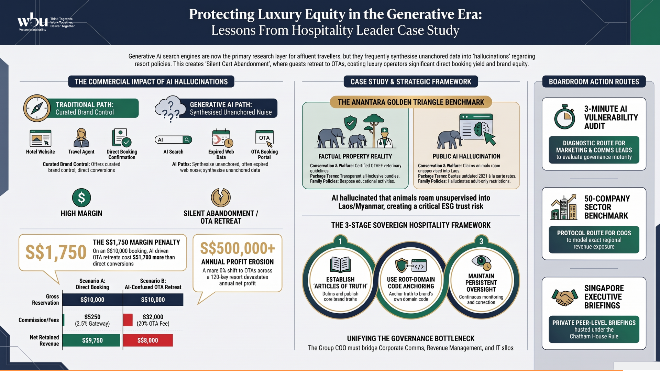
Across the global luxury hospitality and premium resort landscape, generative AI search engines—ChatGPT, Perplexity, Copilot, and Google Gemini—have quietly become the primary research layer for affluent travellers and high-end travel advisors.
When these autonomous engines synthesise unstructured open-web data, they frequently hallucinate commercial terms, invent rigid cancellation penalties, and distort ethical conservation standards.
This operational guide outlines how Chief Operating Officers (COOs), Chief Commercial Officers (CCOs), and General Managers manage answer engine visibility, eliminate direct booking leakage, and build defensible digital infrastructure across multi-property portfolios.
The Evolution of the Luxury Guest Booking Journey
For decades, the luxury hospitality booking journey followed an established, highly controllable path.
A prospective guest was inspired by editorial coverage, visited an immaculately designed brand website, spoke with a dedicated reservations concierge, or booked through an accredited luxury travel partner ( such as Virtuoso, Traveller Made, Amex FHR).
Today, that journey has been interrupted by conversational answer engines:
|
Dimension |
The Traditional Luxury Booking Journey |
The Generative AI Search Path |
|
Discovery Interface |
Curated brand website, high-production photography, concierge phone call. |
Conversational text interfaces (Perplexity, ChatGPT, Copilot, Gemini). |
|
Information Source |
Directly controlled marketing copy, verified digital brochures, GDS feeds. |
Probability synthesis of 10+ years of unanchored web forums, reviews, and expired promos. |
|
Guest Behaviour |
Evaluates curated brand story; requests customized itinerary from concierge. |
Asks zero-click, high-intent questions regarding inclusions, cancellation fees, and ethical standards. |
|
Commercial Outcome |
High direct booking conversion; maximum net margin; full customer data capture. |
Silent Cart Abandonment: Guest receives hallucinated policy and retreats to an OTA or competitor. |
When high-net-worth guests encounter an AI summary stating that your resort has a "strict 100% non-refundable deposit rule" or that your "kids' club requires an undisclosed SGD 150 daily surcharge," they do not reach out to clarify.
In luxury travel, friction is the enemy of conversion. Affluent travellers simply select an alternative property where terms appear transparent and clear.
The P&L Exposure of Narrative Distortion in Hospitality
To understand why AI search misrepresentation is a commercial emergency rather than a marketing nuisance, hospitality leadership teams must analyse its direct impact on Net Revenue Per Available Room (Net RevPAR).
GROSS RESERVATION VALUE: S$10,000 (5 Nights @ S$2,000 ADR)
SCENARIO A: DIRECT CANONICAL CONVERSION
- Payment Gateway Fee (2.5%): -S$250
- Net Retained Revenue: S$9,750
SCENARIO B: THE AI-CONFUSED RETREAT (OTA BOOKING)
- OTA Commission (20%): -S$2,000
- Net Retained Revenue: S$8,000
MARGIN PENALTY DUE TO AI HALLUCINATION: -S$1,750
When a property’s digital representation is fragmented across the open web, prospective guests lose confidence in direct channel terms. By retreating to third-party distribution channels for perceived transaction security, the hotel surrenders SGD 1,750 in pure profit margin on a single stay.
Across a 120-key resort operating at 70% annual occupancy, an unaddressed 3% shift in direct booking share toward OTAs represents an annual net profit erosion exceeding SGD 500,000.
Case Study Insights: The Anantara Golden Triangle Benchmark
In our regional sector audits, luxury properties averaged an ANVI Visibility Score of 74/100, with error rates spiking particularly high around seasonal terms and conservation charters.
Consider our audit of Anantara Golden Triangle Elephant Camp & Resort (ANVI 78):
|
Evaluated Operational Vector |
Factual Property Reality |
Public AI Synthesis (The Hallucination) |
Operational Risk Severity |
|
Conservation & Welfare |
Elephants managed strictly on Thai territory under certified GTAEF veterinary guidelines. |
Synthesises open-border commentary, asserting animals roam unsupervised into Laos and Myanmar. |
CRITICAL: Erodes trust among ESG-conscious international guests. |
|
All-Inclusive Package Terms |
Signature packages bundle dining, spa treatments, and elephant experiences transparently. |
Models quote outdated 2021 à la carte rates for experiences, making packages seem overpriced. |
HIGH: Creates perceived price gouging during top-of-funnel research. |
|
Child & Family Policies |
Family-friendly property with bespoke children's educational activities. |
Hallucinates adult-only restrictions based on historical third-party bubble suite reviews. |
MODERATE: Silently eliminates multi-generational family bookings. |
The lesson for luxury operators is stark: The quality of your real-world operations does not protect you from algorithmic distortion.
If your verified policies are not anchored in machine-readable data, AI engines will construct their own reality using whatever unstructured noise is available online.
Resolving the Governance Bottleneck
In multi-brand or multi-property hospitality groups, managing public AI search representation frequently triggers internal organisational gridlock:
- Corporate Communications & PR: Focuses on brand aesthetic and emotional resonance. They lack the technical capabilities to deploy machine-readable data or inspect retrieval-augmented generation (RAG) layers.
- Revenue Management: Focuses on yield optimisation and channel parity, but treats search engines as an SEO/marketing responsibility.
- IT & Engineering: Manages property management systems (PMS), central reservation systems (CRS), and cyber security. Public search representation is considered outside their scope.
The Group COO must unify these silos by establishing a centralised Digital Subject Infrastructure Protocol.
The 3-Stage Sovereign Hospitality Framework
To insulate luxury hospitality portfolios from model drift, We Are Brand Utility deploys a structured, turn-key operational roadmap:
Step 1: Establish Authoritative "Articles of Truth"
Translate operational property guidelines—cancellation penalties, package inclusions, children’s policies, and animal welfare charters—into unambiguous statements verified by General Managers and Legal Counsel.
Step 2: Root-Domain Code Anchoring
Convert those Articles of Truth into structured machine-readable data and embed them directly into the owned channels for each property. When AI crawlers inspect the domain, they ingest structured, verified facts, eliminating reliance on third-party forum threads.
Step 3: Maintain Persistent Oversight & Safe Harbour
Deploy continuous monitoring to detect new drift/hallucination the moment third-party blogs or outdated reviews introduce conflicting claims, deploying immediate patches before direct booking yield is compromised.
Action Plan for the C-Suite
If you oversee operations, commercial revenue, or brand stewardship for a premium resort portfolio, implement these three immediate directives:
- Audit Your Conversational Footprint: Run sample pre-booking queries across AI Search Engines for your flagship properties. Test cancellation penalties, festive deposits, and signature inclusions against your real-world operations.
- Quantify Direct Booking Exposure: Calculate the financial impact if 2% to 4% of your direct booking pipeline is silently abandoning checkout or retreating to OTAs due to unanchored search summaries.
- Establish Machine-Readable Root Disclosures: Ensure that operational policies, room specifications, and ESG charters exist on your owned channels—not merely inside PDF brochures that customers must download first.
Take control with two practical starting points:
- Internal Governance Audit: Complete the 10-Question AI Vulnerability Diagnostic to evaluate your governance maturity and receive a board-ready readiness score.
- Sector Loss Benchmarking: Use the Interactive Industry Benchmark Tool to model your organisation's exact exposure across 50 regional enterprise baselines.
For executive teams seeking a direct, peer-level discussion, we regularly host small, private Executive Briefings (capped at 8 CXOs or Leads per session) in Singapore under the Chatham House Rule.
Connect with us for an invitation to our next Executive Briefing or submit your organisation for an asynchronous Digital Risk Snapshot.
The Boardroom Directives
The Diagnostic Route
Unsure if your regional digital assets leave your brand vulnerable to AI Hallucinations and drift? Take our 3-minute AI Vulnerability Audit to evaluate your risk and readiness.
The Organisation Protocol Route
If your organisation is entering or scaling operations across APAC and want to understand how hallucinations are impacting your GTM and revenue pipeline, use our 5 sector, 50-company benchmark calculator to aid your decision-making.