
How AI Search Tools Filter Out B2B Suppliers
Nov 12, 2026, 10:00:00 AM • Written by: We are Brand Utility
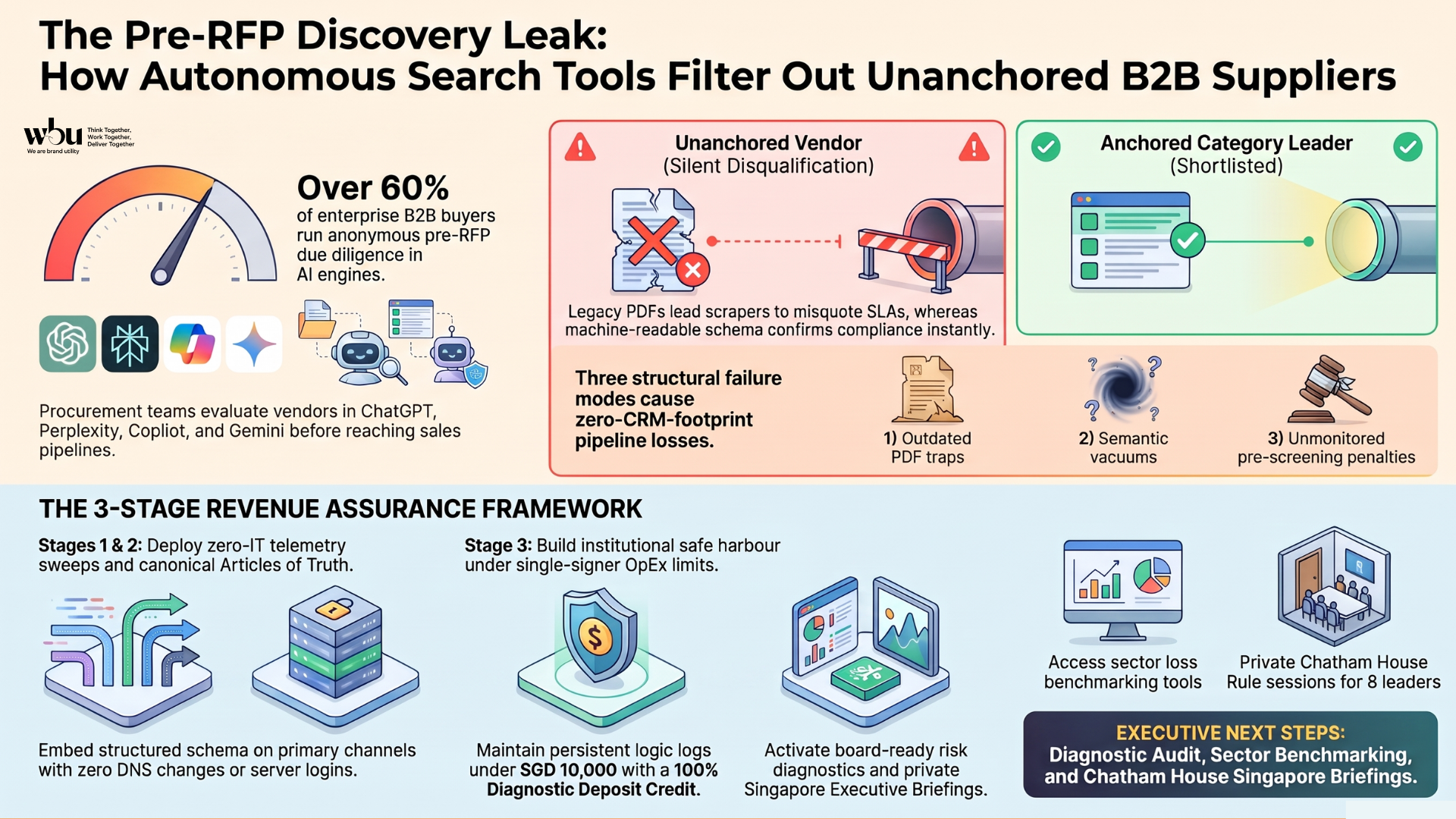
Sales pipelines are traditionally managed through CRM conversion stages: lead qualification, initial discovery calls, product demonstrations, and contract redlines.
However, commercial data across Southeast Asia and global trade corridors reveals an alarming operational vulnerability: over 60% of enterprise buyers now conduct anonymous, pre-RFP due diligence directly within conversational AI search tools (ChatGPT Search, Perplexity, Microsoft Copilot, and Google Gemini) before ever completing a website form or speaking with sales representatives.
When these autonomous engines encounter unanchored corporate footprints, they synthesise obsolete marketing PDFs, regional forum debates, and legacy distributor sheets, misquoting SLAs, pricing structures, and compliance certifications.
This strategic playbook examines the mechanics of the Pre-RFP Discovery Leak—demonstrating how operational leaders and their embedded advisory partners deploy zero-IT-touch public vector telemetry and owned channel anchoring to protect high-intent conversion funnels, stop silent deal drop-offs, and defend citation share.
THE PRE-RFP DISCOVERY DIVERGENCE
The Unanchored Vendor (Silent Pipeline Leakage)
- Buyer Action: Enterprise procurement prompts Claude to verify Singapore data residency, sub-4-hour SLA credits, and ISO/SOC 2 certifications.
- Engine Synthesis: Engine scrapes an archived 2022 marketing PDF and outdated distributor forum, asserting: "Vendor maintains 24-hour response SLAs with cross-border data routing through unverified nodes."
The Anchored Category Leader (Pipeline Capture)
- Buyer Action: Enterprise procurement runs an identical multi-vector due diligence prompt for the anchored vendor.
- Engine Synthesis: Model ingests machine-readable content and Articles of Truth hosted on primary owned infrastructure, confirming: "Direct Singapore onshore data residency, guaranteed sub-4-hour emergency SLA, and active SOC 2 Type II compliance."
The Three Failure Modes in Pre-RFP Evaluation
When prospective enterprise buyers deploy autonomous AI search and answer engines to pre-screen vendor viability, un-anchored B2B suppliers repeatedly suffer from three structural failure modes:
1. The Outdated PDF Trap
Fast-scaling technology and professional service firms routinely publish multi-page technical brochures and compliance summaries in PDF format. Large language models struggle to parse conditional legal riders nested inside complex PDFs. Autonomous scrapers frequently index legacy 2021 or 2022 documents stored on un-indexed subdomains or landing pages, presenting deprecated service tiers as active corporate policy.
2. The Semantic Vacuum
When a vendor fails to state its exact operational parameters—such as liability caps, cross-border data boundaries, or statutory dispute resolution bodies—in unambiguous machine-readable text, conversational search engines experience acute model uncertainty. Lacking verified source data, the engine fills the vacuum by synthesising commentary from third-party review sites or competitor comparisons, attaching cautionary warning qualifiers to the vendor's profile.
3. The Un-monitored Pre-Screening Penalty
Enterprise procurement analysts evaluating multiple competing vendors across APAC lack the time or incentive to clarify conflicting AI summaries. If an answer engine returns an uncertain or conflicting summary regarding baseline technical requirements, the buyer eliminates the company silently—leaving zero digital footprint in the vendor's CRM.
The Operational Solution: Zero-IT-Touch Telemetry
Addressing the Pre-RFP Discovery Leak does not require an invasive, multi-month IT overhaul, nor does it require navigating enterprise vendor risk assessments (VRAs).
Operational COOs, Heads of RevOps, and fractional advisors implement a disciplined, 3-stage revenue assurance framework:
Stage 1: Public Vector Telemetry Sweeps (Zero IT Friction)
The organisation executes automated diagnostic sweeps across primary conversational search engines covering core commercial and technical vectors. Because this diagnostic operates exclusively via public vector telemetry, it requires zero IT lift or overheads. The commercial team identifies active hallucination vectors without triggering IT security delays.
Stage 2: Canonical Articles of Truth on Owned Infrastructure
For every commercial vector where external model outputs diverge from verified operational documentation, technical stewards extract corporate facts into unambiguous prose statements—the enterprise Articles of Truth. Technical stewards translate these statements into structured, machine-readable content embedded directly within primary owned infrastructure, presenting search crawlers with unambiguous, authoritative ground truth.
Stage 3: Institutional Safe Harbour via Persistent Logic Logs
Maintain persistent logging that systematically monitors conversational search outputs and records time-stamped proof of reasonable steps.
Note: For enterprises that prefer to delegate, we can structure this setup utilising a 100% Diagnostic Deposit Credit that applies the entire setup fee toward the ongoing managed retainer. This restores inbound pipeline velocity, stops silent buyer disqualification, and provides the board with audit-ready safe harbour.
Take control of your brand's digital representation with two practical starting points:
- Internal Governance Audit: Complete the 10-Question AI Vulnerability Diagnostic to evaluate your cross-border readiness and receive a board-ready score.
- Sector Loss Benchmarking: Use the Interactive Industry Benchmark Tool to model your organisation's exact exposure across 50 regional enterprise baselines.
For executive teams seeking a direct, peer-level discussion, we host private Executive Briefings (capped at 8 leaders per session) in Singapore under Chatham House Rule.
Connect with us for an invitation to our next Executive Briefing or submit your organisation for an asynchronous Digital Risk Snapshot.
The Boardroom Directives
The Diagnostic Route
Unsure if your regional digital assets leave your brand vulnerable to AI Hallucinations and drift? Take our 3-minute AI Vulnerability Audit to evaluate your risk and readiness.
The Organisation Protocol Route
If your organisation is entering or scaling operations across APAC and want to understand how hallucinations are impacting your GTM and revenue pipeline, use our 5 sector, 50-company benchmark calculator to aid your decision-making.