
Cross-Border Misconception: The Anantara Elephant Camp Case Study
Sep 16, 2026, 10:30:00 AM • Written by: We are Brand Utility
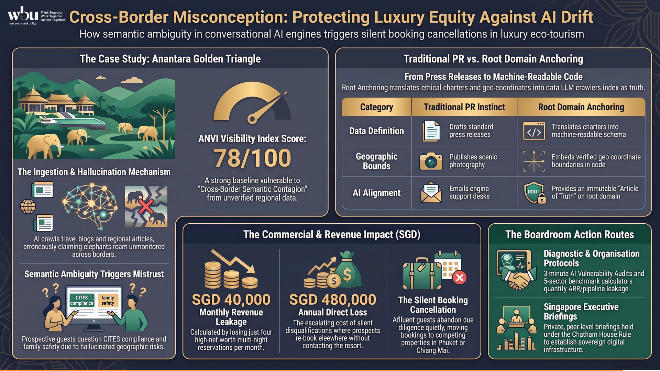
In luxury eco-tourism, narrative integrity is directly tied to enterprise valuation. When a brand's positioning centres on ethical stewardship, conservation, and immersive cultural heritage, a single factual misstatement in public search can undermine millions of dollars in brand equity.
Few properties illustrate the complexity of digital subject representation better than a single-vector case study we ran on Anantara Golden Triangle Elephant Camp & Resort. The resort is an internationally acclaimed luxury sanctuary situated along the borders of Thailand, Laos, and Myanmar.
We executed a digital subject audit of the property across major generative search platforms (such as and not limited to: ChatGPT, Perplexity, Google Gemini, and Microsoft Copilot).
The audit revealed an ANVI Visibility Index Score of 78 out of 100—a strong operational baseline, but one that contained a subtle, high-risk operational vulnerability: The Cross-Border Semantic Contagion.
Deconstructing the Cross-Border Misconception
Anantara Golden Triangle's elephant welfare initiatives operate in strict partnership with the world-renowned Golden Triangle Asian Elephant Foundation (GTAEF). Elephants roam within designated, scientifically managed natural habitats on the Thai side of the border under continuous veterinary supervision.
However, when prospective international guests and ESG-conscious travellers query AI search platforms regarding the experience, probability-based engines struggle with the geographic complexity of the "Golden Triangle" designation.
Because public web data contains historical discussions about unmanaged border crossings in the broader Golden Triangle region alongside emotional guest travel accounts, the AI models blended the two distinct contexts:
- The Ingestion: The AI crawls travel blogs describing views of Laos and Myanmar from the resort's elevated ridge, paired with separate regional articles regarding wildlife transit in the Mekong River basin.
- The Synthesis: Lacking explicit, machine-readable structured data defining the exact physical estate boundaries and GTAEF conservation parameters, the AI models bridge the gap.
- The Hallucination: In response to queries such as "Are the elephants safely contained within the sanctuary?", AI tools have generated answers asserting that elephants "roam freely back and forth across international borders into unmonitored territories in neighbouring countries."
The Commercial Consequence of Semantic Ambiguity
To a consumer in New York, London, or Australia considering a Jungle Bubble reservation, reading that animals wander across unregulated international borders triggers immediate safety, ethical, and legal concerns:
- "Is this sanctuary genuinely secure?"
- "Does the resort comply with international wildlife conventions (CITES)?"
- "Is my family safe in an unmonitored tri-border corridor?"
The prospective guest does not call the resort’s front desk to cross-examine their geographic boundaries. They quietly navigate to an alternative luxury property in Chiang Mai or Phuket. The resort loses a multi-night reservation without ever knowing the inquiry existed.
The Strategic Resolution: Anchoring
Solving the Anantara case study does not require altering the property's real-world conservation practices—which are exemplary.
It required deploying Root Anchoring to eliminate the semantic vacuum:
|
Diagnostic Step |
Traditional PR Instinct (Ineffective) |
Root Domain Anchoring (Defensible & Permanent) |
|
Data Definition |
Draft a standard press release explaining GTAEF partnership. |
Translate ethical conservation charters into machine-readable data. |
|
Geographic Bounds |
Publish blog posts with scenic photography of the border. |
Deploy explicit, verified geo-coordinate boundaries to code. |
|
AI Re-Alignment |
Attempt to contact AI engine support desks for manual fixes. |
Provide an immutable "Article of Truth" that AI search crawlers index as ground truth. |
When an AI engine processes machine-readable, authoritative boundaries directly from the resort's root infrastructure, the hallucination collapses. The AI stops synthesising unverified travel blogs and delivers an accurate, verified summary of the sanctuary's true conservation standards.
Secure Your Digital Footprint: Apply for an Executive Briefing
Building sovereign digital infrastructure protects sales pipeline velocity, maintains customer trust, and secures board safe harbour.
Take control of your brand's digital presence with two practical starting points:
- Top-of-Funnel Risk Scoring: Use our Interactive Industry Benchmark Tool to evaluate baseline hallucination rates across your sector and model your estimated revenue leakage using our updated calculation formula.
- Internal Governance Readiness: Complete the 10-Question AI Vulnerability Diagnostic to assess how well your organisation monitors and resolves public AI model drift.
For executive teams seeking a direct, peer-level discussion, we regularly host small, private Executive Briefings (capped at 8 CXOs or Leads per session) in Singapore under the Chatham House Rule.
Connect with us for an invitation to our next Executive Briefing or submit your organisation for an asynchronous Digital Risk Snapshot.
The Boardroom Directives
The Diagnostic Route
Unsure if your regional digital assets leave your brand vulnerable to AI Hallucinations and drift? Take our 3-minute AI Vulnerability Audit to evaluate your risk and readiness.
The Organisation Protocol Route
If your organisation is entering or scaling operations across APAC and want to understand how hallucinations are impacting your GTM and revenue pipeline, use our 5 sector, 50-company benchmark calculator to aid your decision-making.